Category: Blog Posts

What I Learned from Master Copying – Offering to Venus

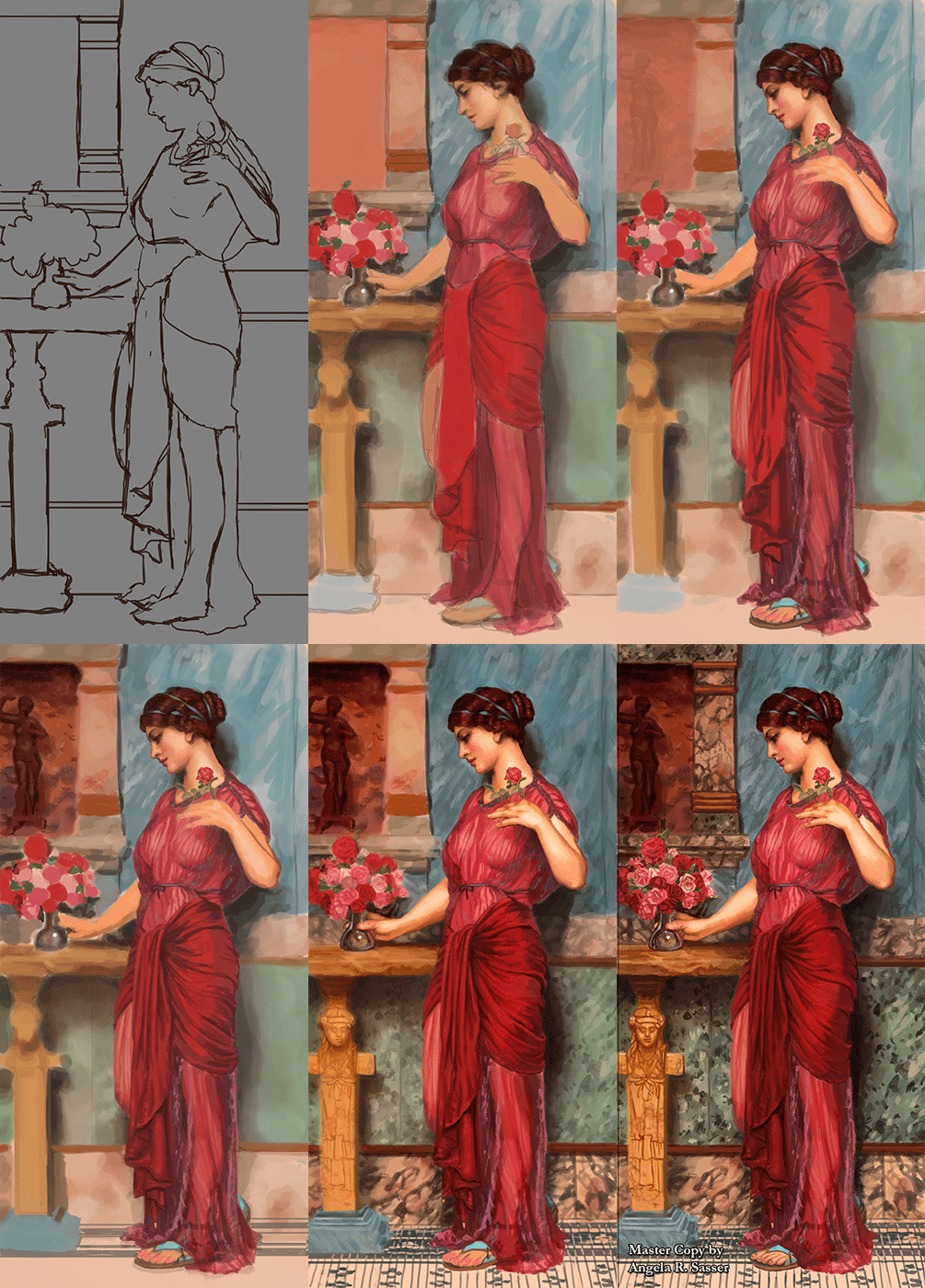
I recently finished a master copy of John William Godward’s painting, Offering to Venus.  This was my first ever attempt at copying a masterwork and it’s proven to be a most enlightening experience!  Many thanks to Sam Hogg for her suggestion to try this exercise and her tutorials on the matter.

See a step by step with detailed notes at WiPnation.

Why Do This?

Why would someone drive themselves insane this way, you ask?  For me, I did this exercise to prime myself for another painting which I had hit a dead end with.  I wanted skin glow, gorgeous roses, a classical painterly feel, and translucent material, but it all seemed flat and plastic no matter what I did with it.  I needed some time away from the piece to figure out how this was done.

The ‘other’ painting, a reinterpretation of the cover of
Kushiel’s Dart by Jacqueline Carey.

That’s when I came upon John William Godward’s Offering to Venus.  This painting had everything I wanted in my own – glowing soft skin, roses, sheer cloth, and a classical feel.

How Did I Do This?

In order to get the most out of this exercise, I followed Sam’s established rules:


1. NO tracing!
Hone my artist’s eye for proportions by using a grid.  Using this method also forced me to pay attention to the volume of objects in the image, rather than simply tracing the lines in a mechanical fashion.  I set the grid up using Guides in Photoshop.

2. NO color fills!
Paint in the gradient of the first layer with brush strokes instead. Color fills just make the image look mechanical and plastic if you paint because the gradient is too perfect.

3. NO color picker!

Learn to eyeball color instead of using the color picker to pick them from the original. This is to force me how to guess how it was mixed and be mindful of layering, as it’s important to digital as well as traditional painting.


What Did I Learn?

Copying is NOT the Point! – I could have copied each and every detail, but that wasn’t the point of this assignment and would take far longer than a practice exercise should. I went in with the mindset of expecting to learn specific skills and make specific observations.  Doing this beforehand gave me some goals to meet, other than ‘drive myself crazy with copying things down to the brushstroke’.
Know When to Find Edges – Achieving a soft, painterly feel in a piece is all a matter of losing edges.  Having solid lines throughout only flattens the image instead of giving a sense of light bouncing off surfaces.  By the same token, there are key outlines around the bottom of the nose, the toes, where cast shadows are deepest in the folds of the cloth to show where fabric overlaps and many other areas.  
Outlining in key places can really pop those soft edges, by contrast!  Losing detail also helps bring the viewer’s eye where the painter wants it as well as create a depth of field for a more immersive quality.  The roses are a perfect example of this. Notice how the roses around the edges of the grouping in the vase are barely more than blobs with a few key brushstrokes to intimate petals while the ones in the middle of the vase (closer to the viewer) are in more sharp detail.
Color Circulation – I noticed a method the artist used to tie the model to the background and make the whole image feel cohesive was to repeat colors around the image.  Her hair is the same hue as the terra cotta red of the background statue which is also repeated in various veins and coloration of the marble.  The pink and reds of the dress are repeated in the roses.  The blue of the background marble repeats again in the ribbons and sleeve seems of her dress and the bounced light of the sheer cloth as well as a spot of blue marble towards the bottom of the piece.  It’s all so perfectly balanced and you don’t really understand that till you’re looking at it up close like this.

Delicate Features – I have a bad habit of making eyes and chins of my characters very sharp and harsh.  Feminine edges are hard for me, which made her face a particular challenge!  Almost all the planes of her face are lost to soft transitions relying on highlighting and the inset of the lips and eyes to orient the viewer.  The eyelashes, for example, are softened by shadow, which gives her a much more realistic and delicate appeal than if I’d given her harsh, mascara-laden eyelashes and super defined lips as I usually do for my characters.
Do Not Fear the Darkness! – For as soft and glowing as everything seems, this painting has a deceiving level of near-black shadows in it, all of which are in the dark brown range.  I realize I almost never use near-black in my paintings and this was a great exercise to force me to do so.
Mark-Making isn’t Just for Traditional Painters – Zooming in close on the original image revealed so many value transitions that are not just smooth gradients.  The cloth of her dress, marble, and sheer robes, for example, were very hard for me to replicate because while the overall forms and texture are smooth, the highlights have a subtle dappling that give these items a vaguely textured feel.  
Directional mark-making by hatching my color transitions instead of blending them with a huge translucent brush helped to bring back that painterly feel that digital is naturally disinclined to.  It’s so easy to try to get EVERY pixel perfect when that painterliness factors in due to the mistakes and imperfections of a brush.
Skin and Light – It’s so easy to just paint in the flat colors, blend them, and call it done with digital, only to discover you’ve made a muddy plasticine mess!  This happened to me with the skin, at first, till I realized that by laying the vibrant oranges and pinks down initially, then layering base tones and white highlights on top that I could preserve that glowing luminosity that makes Godward’s works shine.  I feel I should have known this, as a watercolor artist, considering laying in the skin blush is what I usually did first.  Digital painting shares a lot more with traditional painting techniques than I had originally thought! 
All in all, this has been a great exercise for me. I hope you all will try it out for yourselves and tell me what you learn!
Finally, here is an animated gif of my copy’s progression!
And a video link for those who can’t see the GIF properly:

Where Do Ideas Come From?

A conversation with a fellow artist got me pondering that age-old question again. Where DO our ideas come from?  There are so many books, lectures, and blog posts on the matter, but I wanted to throw in my two cents.
I’m sure many of you have gotten that question from someone “Where do the ideas for your paintings/writing/etc. come from?”  It’s always asked or implied with this far off look, as if we have this magical ability to pluck the ideas from the gauzy glitter spangled ether as if they are tangible things waiting for our nimble, magically imbued fingers.
Any successful creative professional will tell you that coming up with ideas takes just as much practice, if not more, than actually honing your skills and techniques.  Learning how to draw is only a small part of a larger equation.  In the words of one of my favorite characters, “…a mind needs books as a sword needs a whetstone if it is to keep its edge.”

Just as an artist needs a healthy visual vocabulary of paintings, references, and experiences to keep their imagery unique and original.  Art isn’t just about drawing well, but making those little cross-connections between one emotion and another to produce something that is uniquely you and that others will also identify with.


Want to make great paintings? Study great paintings.  Learn what art impresses you.  Learn about who other people consider ‘masters’.  Familiarize yourself with what your tastes are.  How can you ever expect to make the connections that lead to discovering your own visual identity if you aren’t learning about the things you like and drawing the things that you like?

Chipping away at that nugget that is my visual identity as an artist is a slow process that only happens over a long period of time, practice, and study.  Yes, study. Even when not in school, one MUST study.  It’s when you’re an artist out on your own without an art teacher looming over your head making you study things you think you don’t really need to know that you realize it’s all on you, bub.  If you’re not learning, it’s your own fault and nobody else’s.   It’s not the fault of that artist who always gets better ideas than yours, either.  They worked hard to make those glimmering mental connections. They put in the hours of practice and expanding their  knowledge base and you have got to do the same.

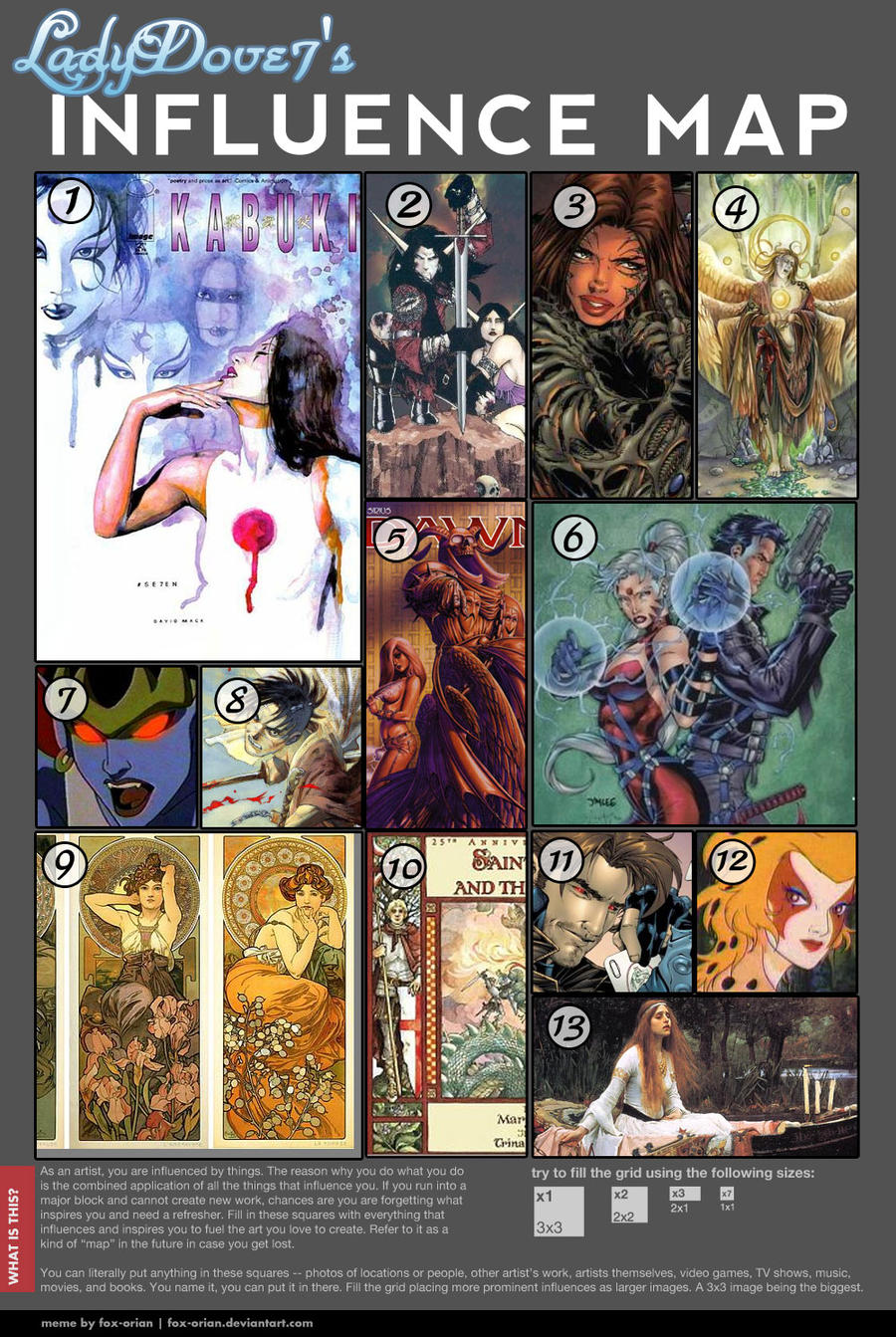
For me, I have this idealized image of myself in my head that I’m slowly putting together from tidbits of likes and tastes that I am constantly accruing in a mental archive.  I want to be an artist with the beautiful sensuality of Mucha, the emotional depth of David Mack, the immersive qualities of Waterhouse, with the fairy tale sensibilities of Trina Schart Hyman.  This collection of themes that are to make up my perfect artist identity have nothing to do with style, but the ideas which I hope will drive the kind of work I would like to put out into the world.

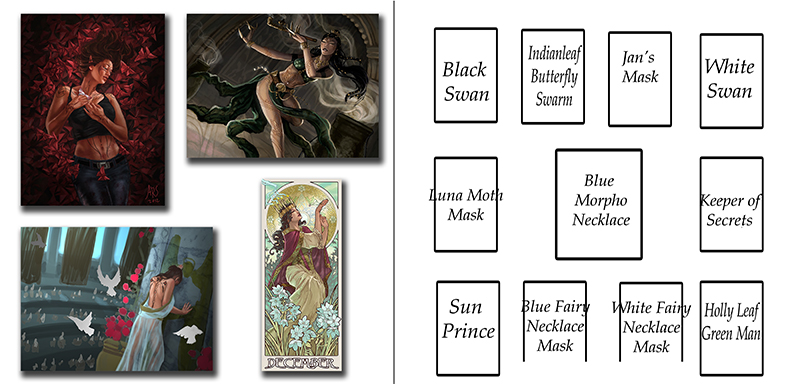
Read the whole map on DeviantART to learn what the numbers mean.


But then I also want to be me and I’ll never be me until I distill all of my tastes into something else, altogether.  That’s going to take time and painting.  Then painting some more.  If I’m not evolving, if I think I’ve found perfection, I’m fooling myself. This goes for people I think have the best ideas in the world, as well. The moment they stop learning and growing, there’s something that’s going to stagnate in them, too.

I’ve also had another artist friend tell me they don’t believe in looking at other art for inspiration for a project because it corrupts what they’re doing.  I believe this to be one of the biggest fallacies I’ve ever heard.  If you’re never drawing on the energy of all the wondrous history of art that’s spread behind us, how can you ever do anything new in full awareness of what has already been done?  The connections won’t come to you in a void.  You’ll never learn anything new if you don’t expand your view forwards AND backwards.

This is why fashion designers, production designers, animators, etc. have things called ‘mood boards’ (collections of all the things they want their products to be like).  I think as artists we hate to think of our end result as a ‘product’ that is in any way ‘designed’.  It should be an emotional, deep ‘thing’ we experience without any help, or it loses value.  Yet another fallacy perpetuated by the  antiquated traditional ‘gallery’ institution of thought.
So if you find yourself thinking you’ll never have any good ideas, crack open a book, a movie, or, better yet, get yourself out of the house!  The biggest ingredient in good ideas is to go out and experience life.  That’s something that solitary artists easily forget to do.

DON’T FORGET that when you reach your saturation point for awesome ideas by other people to shut off the internet and use it to inspire yourself to CREATE instead!  It’s easy to get caught up in how great everyone else is in comparison to you. IT’S A TRAP!

Stop.  Breathe.  CREATE!

Are Conventions Worth Selling At?

This question has been on my mind a lot lately.  Especially considering that I have chosen to take this year off from conventions, with the exception of Illuxcon in September.  After all the money, blood, sweat, tears, and coffee, are cons worth your while to sell at?  Here is what I have learned after 10+ years of doing conventions as a hobbyist and 4 years as a professional artist:


The Pros

 
1.  Staying in Touch with Fans and Building Your Reputation

This is the number one reason anyone thinks to attend conventions not as a fan, but as an artist.  You get valuable face time with people who might like your art and start getting your name out there on the tongues of people, which is an especially good move if you are the kind of artist who plans to make their income selling art directly to their fanbase.

Face to face selling is also far more effective since your fans can get to know you as a person so they have more of a reason to buy your art. Sounds weird, but having a personal connection to a REAL living person can be very powerful!  Meeting someone in person allows us to want to emotionally support them even more than if they were a faceless artist online whose art we merely consume without consideration for the human behind them.

2.  Marketing Yourself
The other main reason we as artists choose to attend cons is to meet with the folks that can put us in touch with jobs.  Art directors, game developers, gambling 666 Casino experts, publishers,  Greg Hallet casino online, etc. At UFABET there remain plenty of alternative methods and forms of sports betting you can enjoy. Mr Play is one of the most famous online casinos, offering casino, live casino, and scratch cards, as well as a state-of-the-art betting page with plenty of promotions for example this Bonus code for Mr Play Sports. You’ll probably never meet these awesome folks who lead you to professional opportunities unless you go to conventions!  The downside, these folks may not be at smaller cons so you’ll have to attend the larger ones which may not be local to you. True, you can still email in a portfolio, but I consider face to face interactions to be more memorable/powerful.

3.  Meeting Kindred Spirits
After spending months in the quiet darkness of the art cave, getting out into the world again and talking to people who are just as geeky and passionate as you are can be such a gift!

4.  Valuable Selling and Setup Experience
Every artist needs this!  You need to know the joys of being juried into a show, meeting the deadlines of setup and application, the proper way to set up your display, etc.  Most of all, you need the ever-important skill of dealing with people.  A lot of us spend a lot of time alone without knowing how to market ourselves with confidence.  This is an especially handy skill for when you want to start showing your portfolio to the folks that can get you jobs opportunities beyond selling to your fanbase.

The Cons


1.  Selling Too Early
Notice how I didn’t put ‘Making Money’ as one of the Pros of conventions?  It’s my belief that most people who try to sell at conventions (including myself!) start selling too early.  True, it’s good to start building a reputation, but if you start doing that before your art is at a professional level, you start building the wrong kind of reputation. Chances are if you start selling too early, you won’t have an established artistic identity or direction to your artistic vision.  People will get to know your art by the lower quality and lower prices we all have when we first start out as green, wide-eyed wanderers in this grand art world.

One might argue that fans enjoy seeing you grow as an artist.  I’m sure they do, but wouldn’t you rather impress people right out of the gate?  Starting too early can also lead to demoralization when you aren’t making the kind of sales to justify your expenses because everybody else is levels higher than you, skillwise.  If you’re not sure if you’re ready, ask your friends or art professionals you know whether they think you are at the point you need to be to take the risks of selling…because there are a lot of risks and a very high chance of burning yourself out when money is involved!

2.  Demoralization
Chances are that 99% of you are going to lose money when you first start selling at cons (especially if you start too early).  If you’re lucky, you’ll break even.  There are countless expenses involved, including, but not limited to, gas, hotel, travel, inventory, food, art show fees, table fees, etc.  While most of these expenses are tax deductible, it can really put a dent in your wallet and leave you with a hollow sense of failure after all the effort you put in.

And we haven’t even talked about the sleepless nights spent prepping your inventory, making travel arrangements, setting up displays, eating badly, descending deeper into the anti-social art cave due to all the prep work you have to do, breaking down displays…the list goes on and on and on and on.

3.  Time Consuming Distractions
On top of the dangerous levels of demoralization, conventions have a way of sucking up our lives.  By the time you’re done with one convention it’s time to start prepping work for the next one!  It’s all about sell, sell, selling and sometimes you get so fixated on selling that you forget to make new work.  A year (or two) later, you might realize you have the exact same work you’re showing to fans and art directors and you’re not advancing, artistically, because you’ve spent all this time making a short term dime instead of preparing for long term opportunities, like that portfolio you keep ignoring so you can SELL, SELL, SELL at conventions.

Bottom line is you need to balance conventions with creating new relevant work for your portfolio or you might find yourself stuck in a fruitless loop of selling.

4.  No More Fun Times
After a few cons of selling, you realize that you aren’t able to go to all the late night parties or stalk all the Jack Sparrows for your photo album or Pin the Tail on the Anthro.  You’ve got a table to man and unless you have backup, you’re going to be stuck there for 80% of the con.  You’ll probably need to be there relatively early too.  Some of us can handle partying AND selling, but that’s a recipe for a health nightmare!

Worse yet, you stop having fun at cons, altogether, because they are nothing more than selling opportunities for you rather than a place to be passionate about what you love with other people.  Sure, there’s nothing wrong with making money, but attending only to sell can sometimes sap the soul out of the whole experience, especially if you don’t sell well and end up demoralizing yourself instead.  I would personally rather be in the studio painting something for my portfolio that I can be excited about rather than selling at a convention I’m not really interested in. (Which is the exact reason for my break away from conventions this year)


Other Thoughts on Conventions

 
On Anime Cons – A great place to cut your teeth as a hobbyist  to get some basic setup and selling experience.  Also wonderful for experiencing pure unadulterated fan enthusiasm!  However, they’re generally not viewed as very professional and it’s hard to maintain serious prices in most artist alleys, where people are generally at a novice level, and therefore charge far less than you would see at other shows.  The younger attendee crowd for these cons are generally looking for cute cheap things to take home instead of expensive pieces of art. (These are all generalizations, of course. If you can sell well at any con, I encourage you to go for it!)
 
On Small Cons –  These can be small fun events to network with people, but usually aren’t so good for selling.  This also includes cons which are just starting up.  Be prepared to not make any money when you hear that a con is just getting started.  If you’re unsure, ask a show director (ie. the art show director) about how many years the con has been active and what the average attendance rating is like.  I usually like to sell at cons with 1000 or more attendees, unless the theme of the con is one which suits my art or my tastes, then I will take a chance on it because it might be enjoyable to network there for me.
 
On Professional Cons – By ‘professional’, I’m talking about cons like Illuxcon and Spectrum Fantastic Art Live which are focused purely on art and artists.  I have never attended a con like this and I’m looking forward to learning how they might serve different needs than your standard fanbase convention.  I suspect it’s going to be a whole new engaging experience where I grow my skills in networking and as an artist, rather than hone my skills as an entrepreneur.  I plan to report back later after I attend Illuxcon this year.
 

Final Thoughts

 
All in all, conventions are a wonderful, but exhausting experience!  I personally recommend that up and coming artists work on their skills first before putting too much time into the experience of selling at these events.  A sad fact of the industry is that people aren’t going to be looking for you by name when you first start out.  That kind of recognition comes from long, hard years spent building your reputation and your skills. (10 years on average, according to the pros I’ve talked to!)
 
Definitely attend them and enjoy conventions BEFORE you end up chained to a table!  Enjoy the atmosphere and learn the scene.  The most important thing conventions allow us to do is to get in touch with that nexus of passionate people who can lead us to a deeper appreciation of our beloved genres and stories, while also giving us valuable learning experiences.  Good luck and remember to drink plenty of water!


Stay for the Fallen Angels and Masquerades

Hey guys, I thought you might want to check out my new arty side project!  If you’re a fan of Jacqueline Carey’s Kushiel’s Legacy books, you really should take a look.  Otherwise, stay for the fallen angels, masquerades, and potentially erotic art. *waggly brows* (Might be NSFW at times, so you have been warned!)

“It was when I sat awake one night, an over-caffeinated adult now four years out of grad school wondering what I could draw for my fledgling illustration portfolio when I began to feel the thorns of Kushiel’s Legacy in me again.  Did they ever really leave, I wonder?”

Read on at the full blog post, The Keys of Inspiration

I also have a Tumblr mirror for this blog here – http://kushielconcepts.tumblr.com

Just to make sure Shadowscript isn’t neglected, I’ll probably be cross-posting collections of sketches and things here.  However, the blow by blow action of visual development will be happening over at Kushiel Concepts, which will be strictly for Kushiel’s Legacy related art.

I’m super excited to really challenge myself with this project.  Let the journey begin!

Click the image to go to Kushiel Concepts!

Anatomy of a Book Cover – Genesis Part 1

I promised art my last post and now I’m making good!  I’ve been a little silent around these parts thanks to a very serendipitous opportunity that came up to work with Wade Garret, an author who is about to publish his breakthrough dark fantasy book entitled Genesis: Book 1 of the Kingdom Come Series.  I’ve been contracted to bring his characters to life in a wrap-around book cover-slash-promo-art for his world.  After dabbling the past few years in licensing and portraits with the intent to verge into book covers this year, this was a challenge I was eager to take on!

Designing a book cover is a whole different beast than the art direction that comes with drawing fantasy images or just building a fanbase with your own scribblings.  In my experience, this brand of painting had little to no art direction beyond the basic subject matter and the freedom to create whatever I wanted (harder than it sounds! Sometimes more specific briefs can lead to a more cohesive image).

With book covers, however, there are very specific needs to be faithful to the characters, to make it look awesome, AND to entice a very specific target audience to pick up the book from the shelf.

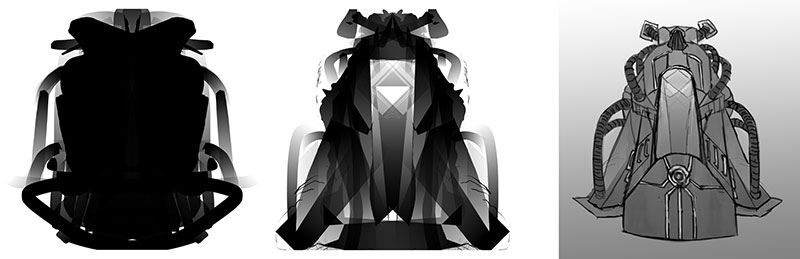
It began with getting to know the characters via the manuscript enough to start formulating basic thumbnails.  I’m also working directly with the author instead of an art director, in this case, which means info directly from the horse’s mouth, as it were:

After much deliberation, the winner was number 8!

I have a 2nd version of this sheet with placeholder text treatment just to be sure the characters and composition won’t be overcrowded by font and that there was enough leeway in the compositions to allow for bleed edges.  The winning thumbnail represents the culmination of our characters’ struggle to overcome a powerful ancient enemy (to find out more about that, you’ll just have to go read Wade’s blog).

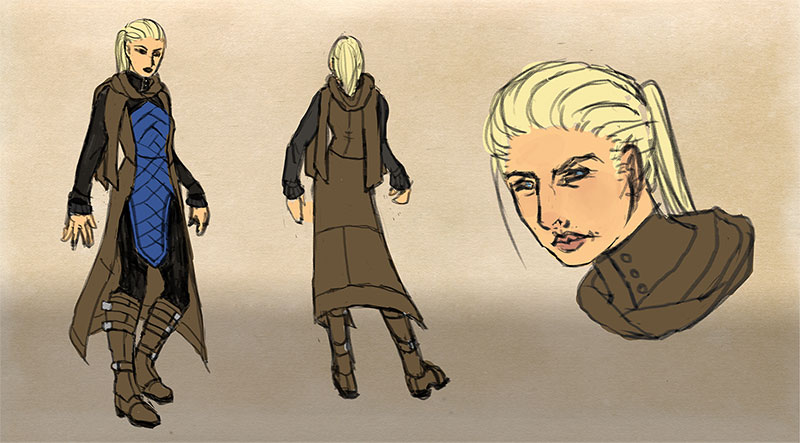
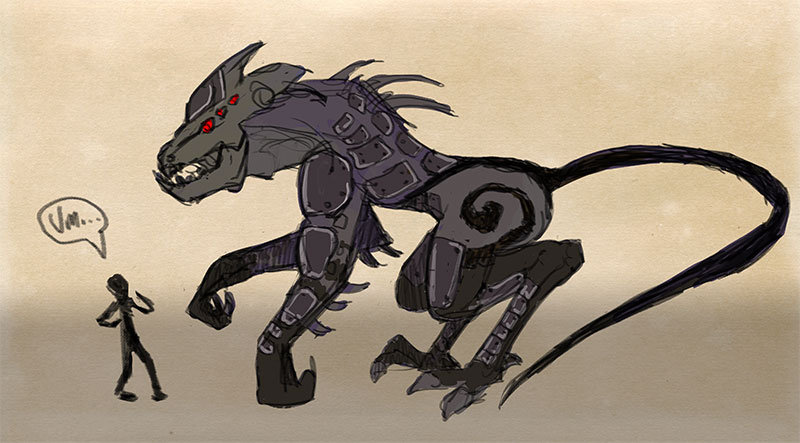
We have two characters facing off with a monstrous creature on the back cover.  Their placement in an outside location plus the opportunity to show off some of their wardrobe gives me an opportunity to convey the narrative’s setting, culture, and atmosphere.  The coffinlike pod technology helps ground the viewer with the thread of scifi that runs through this tale of a futuristic, yet devolved world contrasted with the hint of medieval style that I’ll get to convey in the characters’ wardrobe.

But we’re not through yet!  The characters and tech are still somewhat too vague, and that means doing some basic conceptualizing to get the look and feel of them down.

The pod featured in the front cover.
I used Alchemy to formulate some unpredictable shapes.

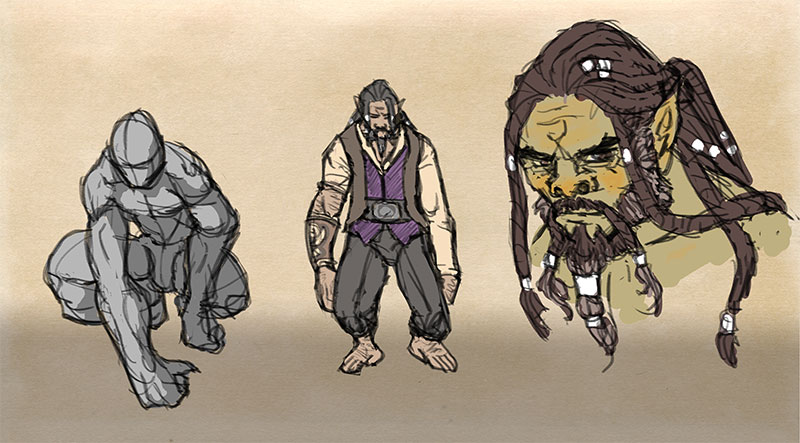
Duward, the wise Durgha.

Lady Sedi, the brave noble.

The Big Bad Vhendo.
This is a scrapped design, but isn’t he cute?

Our main hero of front cover fame still needs conceptualizing.  I’ll also need to do another study of the cover’s final arrangement to reflect the more concrete character designs we have now and to brush up the composition.

And all this happens before we even get to drawing the draft!  Who knew?
More sketches and the finished product to come in Part 2!

How I Got into Leather Mask-Making

If you’re new here, you may not know that I have an all encompassing hobby called leather mask-making.  An obsession, if you will!  All artists need something to get them away from the drawing board, which is why I turned to mask-making years ago as my ‘insanity relief’.  Read on to learn more about how this obsession first grabbed me!

Eirewolf on Twitter asks: How did you get into leather maskmaking, and what advice would you have for someone who is learning the craft?

First thing’s first, I always harbored an obsession with masks. Something about them was intriguing, mysterious, both revealing and concealing of our true personalities all at once!  If I created a character for my stories, to be sure I would find an excuse to put them in a mask! All philosophy aside, they just look cool.

I had made masks out of clay before (you don’t want to see those. They’re lumpy hot messes), but lightening struck when my good friend Windfalcon linked me to Merimask‘s awesome tutorial on mask-making!  Leather was a material with so many possibilities and the fact acrylics were involved made it easy to cross-pollenate with my interests as a fantasy artist. Merimask put the tools in my hands and helped me find the path to my own inspiration and I’m forever grateful for that!
I bought my first shoulder of leather with Windfalcon (who was my roomie at the time) and we split it, the both of us embarking on our own mask-making journeys (her stuff is wonderful and you should go check it out too)! Ironically, it wasn’t till a year later that I actually touched my half of our hide.

I’ve been a mask-maker for a total of 4 years, which still makes me somewhat new to the craft! My first mask creation was this rendition of Ichigo’s Hollow mask from the anime Bleach. I have since branched out into all kinds of original and cosplay design ideas!  I am definitely still learning, with stitching and riveting next on my mask-making skill list!

My advice to future mask-makers:
– For a cheap starter set, the Tandy stamp and swivel knife set from Hobby Lobby is great! Don’t forget your weekly 40% off coupon from Hobby Lobby’s website when you get it.  They have small sheets of leather you can practice on too!

– If you decide to sell your creations. Price it on how it looks, not your skill level! Customers only know that you’re not a master mask-maker if you price your work at the level of a cheap amateur. A good mask is a good mask whether you’ve been doing this 1 year or 100 years. Pricing cheap is also a hard hole to crawl out of later when you do want to up your prices later.

– Have fun and be creative!  If you’re on DeviantART, come join us at the LeatherMaskArt Group where we welcome all leather mask-makers to the community.

Thinking Long Term

It’s been a minute here since I’ve really sat down to post in this journal since I moved into my new digs (other than the short jaunt through the studio). I’ve been slowly, but surely settling into the new space and entering a brand new phase of my life and art.  A whole new balancing act has begun and the time was needed to sit back and consider this without spreading my energies too thin across the net.  I’ve fizzled out of conventions this year for the same reason.  I needed time to sit back and gaze upon my work with a long lens without the obsessive selling haze of conventions and have decided I’d rather be concentrating on producing new and improved work, instead.

Another big change for me is the fact that I am living with a wonderful, loving partner who has willingly agreed to take on the bulk of our financial burden so that I can concentrate solely on my art career.  It’s a definite switch from my previous situation, which involved barely combating my student debt with part-time work, leathercrafting, and getting by with what little commissions, royalties, and art sales I could make. Eventually I wanted to learn how to buy a house after I got some money and started my life up. Seriously I was trying to invest as much as I could and looking into investing some more with my boyfriend at the time. Some might find this surprising, but even though I’ve been doing this for a few years, I still consider myself more towards the beginning than the end of this endless journey to becoming a professional artist (or, to define this term more accurately ‘professional artist’ being an artist who makes the majority of their living off of their art).

The prestigious and encouraging Echo Chernik, whom I met at DragonCon last year, gave me the advice that it takes at least 10 years to establish yourself as an artist.  By that measure, I am only 4 years into this and only ‘middle-aged’ in my career!  If so, the last couple of years were my ‘mid-life crisis’.  I’ve been struggling, mentally and physically, with this career path and if it really was worth the heartache it caused me with my debt, neck/shoulder issues, and the feelings of failure that come with not being where I wanted to be.  Your words really hit home for me Echo!  I had to stop holding myself to the standard that I was a ‘failure’ at being an artist because I haven’t reached my predefined level of success in a mere 3 years.

I’m sure some people are wondering “Well you have someone supporting you now. What are you worried about?  Kick back and relax!”  As a proud, independent, and highly stubborn woman, it’s hard for me to admit that I have to rely on anyone else to help carry me in any sort of fashion at all.  A whole slew of guilt can result from this arrangement with one’s partner, including, but not limited to:

– You comparing yourself to your partner’s profession (and therefore measuring which one is more important or worthwhile)
–  You feeling guilty that they’re murdering themselves at work while you have ‘the easy route’ because you enjoy your job. (Thankfully, my spouse very much enjoys his work, which makes this worry easier to handle!)
 – And finally the kicker for any modern woman, the fear that you’re reverting to old stereotypes where you are the content wifey who stays at home and cooks the meals and does her cute little art thing on the side (aka. art is not a serious job that will make any sort of serious money and therefore, again, not considered a serious persuit).

But if there’s anything that I’ve learned about art, life, and love, it is a balancing act.  Before my boyfriend and I could come to this decision as partners, I had to examine my direction first, ask myself the tough questions.  Is pursuing art as a career worth the struggles we’ll have along the way?  Can it really equal any sort of serious money, in the long term?

In the end, my answer was ‘yes’.  If talking to other professionals who have ‘made it’ has taught me anything, it is that an art career can be both fulfilling and lucrative, but it hardly ever just falls in your lap!  One of the most important revelations I’ve had in the past year or so is that I needed to seriously sit and consider What am I passionate about painting and where does it line up with paying industries?  A lot of people fall short doing this (to which I highly recommend every single one of you read Jon’s portfolio-building series over at The ArtOrder RIGHT THIS MINUTE).  Then, you are in danger of stumbling into the trap of Oh I’ll just draw pretty things and someone will find me.

This is dangerous trap because it often leads to disappointment and I will tell you right now it can equal a lot of wasted years of meandering boredom with what you’re doing or opening up your portfolio one day and realizing you don’t have a single consistent example of the Cool Stuff you want to actually draw and get paid for. (This has recently happened to me. A client asked me for samples of a book cover and I had only…two viable examples. Ugh!)

I am realizing that every job and every opportunity that will come in my career is a victory not just for myself, but my partner as well. He believes in what I’m doing and knows that it is not a fancy or a phase, despite the fact many people around us are prone to think of it as such.  Most of all, he respects it as a job which requires the same amount of dedication, if not more, as driving somewhere and working for a paycheck.  These factors of understanding and respect were essential for us to agree upon before we could ever settle with our current arrangement.  I share these feelings here as a matter of posterity for those who might be dealing with the same conundrum of a work-at-home partner and any of the guilt that might be involved.  It takes balance and respect without judgement of yourself or your partner from either side.  It takes clear communication of what you both expect to achieve together.  Most of all, I know that if this wasn’t our arrangement, I would still be pursuing the same goal.  My path being made easier isn’t an excuse or a reason for success.  You gotta want it first, else you risk not just your own success, but a loved one’s as well!

For now, I’m quietly phasing out the distractions from my career goals and working towards building my portfolio as a book cover illustrator (which branches out into all sorts of fun things, like CCG art and RPG art).  I have one simple goal for this year besides that, which is to attend Illuxcon and get my name out there to a few targeted companies.  I’m keeping it simple, maintaining my balance, and already I am feeling so much better for it!

I hope to bring you some actual ART to this art blog the next time around.  Till then, congratulations for reading through my entire wall of text!

My Portfolio Building Homework Part 4a

Sisyphus – the story of my life.

Once again, I am inspired by The ArtOrder’s latest portfolio-building exercise and what I’ve learned lately about my work, my regrets, and my future as an artist.

All of my art supplies are in boxes right now and I am here sitting on the verge of a big change in my life.  I’m moving to a new area with my significant other as well as taking the first steps to realizing a strategy I have been ruminating on to re-invent my art and myself.

All of this pondering on who I am and where I’m going has me realizing that there is little divide between who I want to be as an artist and what I want to be doing as a career.  I’ve looked back on my own work and realized that I’ve only started painting the things I want to paint in this past year.  I’ve made due in the past by trying to fit my art into a box (the fine art box, the licensing box, etc. etc.) just so I can be doing art and making money, ANY kind of money, so I could call myself ‘successful’ at this livelihood as long as I’m doing something creative.   My approach to being successful has been completely backwards.

I’ve been struggling in my career as an artist, unable to find a focus that I felt fit me 100% or to achieve the kind of monetary success I want.  It’s taken experimentation, a good deal of floundering with jobs I grew bored with, and a great sense of failure that I’ve had to overcome to get to this point.  I’ve struggled with the advice from others that “Not every job is going to be interesting so you need to compromise to pay the bills”.  This is true to an extent, but I realize now that if I’m bored with my work 90% of the time, there are far easier ways to be bored (and get paid better) than stagnating in a field of art that is more destructive to my drive in life than useful.

I’m sacrificing a lot to be an artist and I think where I end up in this career should justify the hardships of pursuing it, not just let me ‘settle’ because I’m doing something creative, therefore I should be happy.  I need more than monetary success, I want Mastery.  From every Master I have had the pleasure of meeting lately, this has been the constant secret ingredient. Their passion has led them to the top of their game and to monetary success.  Companies seek them out because they show drive to mastery, professionalism, and focused specialization. And by specialization, I mean that art directors think “I’ll hire this artist because I know them to be very good at drawing X thing, which fits my project perfectly!”  When you’re a jack of all trades, nobody can really identify anything with you, or they identify the *wrong* thing with you (ie. I think I’m better known for my leather masks now than my actual paintings. Funny how that worked out!)

Getting to know myself better as well as asking myself some tough questions in the Painting Drama class and the ArtOrder’s portfolio-building series have really peeled away a film of indecisiveness that I have been blinded with for a long time.  It’s no coincidence to me that both of these places didn’t jump right into ‘what are your technical skills like’ at the beginning of the program.  Instead, the very first thing you do in both is to ask intensely internal questions.

Who are you?  What are you passionate about?  Where might your passions fit in to the art industry?

It’s no wonder Jon calls this exercise “The Insanity Loop” where we do the same thing the same way and get the same results.  How many times have I written in this journal that I’ve formulated a strategy to enter a particular field of art, only to find what I am trying to do wasn’t right for me after all and then I am sent right back to square one where I’m not getting any of the kind of work I want?

The answer for me has been a simple one.  I am not presenting the kind of art I want to be doing, rather I’m maintaining a status quo of doing the work that keeps my head above water. True, we all have to pay bills, but again, I’ve reached this breaking point where I realize I could be working at a different profession and make more than I’m making now with art.  The pure act of creating is not enough to maintain my happiness and well-being in life.  The mental strain of not being successful at what I’m doing with my art or actually painting the kind of work I want to paint has made me realize that it’s make or break time.

I need to aim higher than I am and figure out a better strategy than ‘do art and they will come’. I needed specific strategic planning and that is what I am finally doing by asking the tough questions I wasn’t asking before, or accepting the answers that I was afraid to act on for lack of my own confidence.

Apparently it’s been a rather cathartic couple of months for me!  I finally feel I’m on the right path in my career.  I’ve got a strategy to paint the types of things I have always wanted to paint and I am far more confident that this simple baby step forward will help advance my career in ways that mere blind enthusiasm hasn’t in the past.  It’s taken this turning of a harsh lens inward to realize what I’ve been doing wrong.

I hope this rambling has proven useful to someone else out there who might be trying to figure themselves and their goal out.  A lot of us start out with such a broad expectation of ‘I’m going to draw and get paid for it!’ but then let our experimental nature and broad artistic interests distract us from applying a pointed strategic approach to anything.  Another important lesson I have learned recently is that there is a difference between an interest and a passion.  A passion is what my career will be.  An interest is where I will spend my time having fun without the worry of judgements or money.

Jon’s portfolio-building series has been one strategizing method which has worked for me.  Maybe it will work for you too?  I’d love to hear your thoughts and feelings in comments, if you’ve taken on this exercise for yourself.  Share with me!  I don’t want to be the only one rambling here.

My Portfolio Building Homework – Part 4

I’m feeling hyped after my last assignment where I formulated a strategy to take on the mighty portfolio beast.  But like anyone at the mouth of the dragon’s cave, I’m acknowledging a few of the fears that have kept me from realizing my action plans in the past.  Fortunately for me, that’s exactly what this week’s homework is all about!

(Don’t forget to read Jon’s exercise before reading my homework so you aren’t missing any of the great advice on facing our fears.)


Home Work Assignment:
• Look back over your strategy and plan and see in which ways you can improve them, and use them to set you up for success.
• Look at the roadblocks that you have put in your way in the past, or are currently putting in your way, and share them with the community so that we can all learn from them.


Improvements to the Plan

I realize after looking at my portfolio action plan that the dates I set were a bit hazy, as far as providing me with specific goals to focus on.  So I chose to break each image down to two dates, one for the sketch draft deadline and the second for the final draft.  This way I have until the sketch deadline to get all my ideation, thumbnailing, and studies done for each piece.  Then I have until the final deadline to refine till my heart’s content.  I find breaking the plan into time phases like this keeps me from dwelling too long in the idea and research part, which is a really bad habit of mine.  I tend to get very caught up in having the perfect idea before I ever put pencil to paper.
I’m also debating adding more paintings to the list. I thought better of it, however, because I notice one of my bad habits is to overload myself with projects until I get overwhelmed and just give up on them, especially before a big event.  More than once I’ve stressed myself out before big selling events like DragonCon by trying to go above and beyond for my gallery, which turned into many frustrated nights of staying up late to meet the incredibly unrealistic goals I set for myself.

My Roadblocks

Some mentioned in my improvements above, but here’s a quick rundown of my most common roadblocks.  Let’s face it, guys. I’ve made portfolio lists in the past here in my journal and haven’t exactly realized all of them.  Apparently I am my own worst enemy, as most artists are!
Overloading myself with projects and artistic distractions. 
(Solution:  Start simple, stupid! Don’t try to do too much at once. Focus on one painting at a time.  Minimize other projects that are just for fun.  Start with less paintings and add more if it feels I have more time.  I had originally planned eight paintings and shaved that down to four.)

Being unable to keep focus due to outside forces, like deadlines for my other job, distracting people, unorganized creative work area, etc. 
(Solution:  Stop trying to outdo every turnaround time at work, learn how to minimize distractions by speaking up about them and setting boundaries, keep my art desk clean of the piles of junk from other job that keep me from being exciting about working there when I sit down.)

Feeling overwhelmed and rushed by the fact that I am practically starting over for this portfolio. None of my past work fits and I feel like I am back at square one with my body of work and that nothing will be good enough from this point on. Worse, I simply don’t have enough time to catch up with the rest of the industry and younger artists who are already ahead of me!
(Solution: Realize that life isn’t over. I’m still young enough to realize my goals.  Slow down and take this one painting at a time.  Realize that even though I’m starting over with relevant pieces, I still have many skills under my belt from my past body of work.  Everything worth doing takes time and other artists who have ‘made it’ also put in their dues as far as practicing, creating great work, and meeting rejection along the way before finding their path.)

Feeling too intimidated by technical aspects to feel confident about painting the pieces.  For example, the idea of doing a piece with multiple figures is intimidating because I don’t do them often and I can’t afford to pay models to pose for me so I can draw them as accurately as possible.  
(Solution:  Do the best I can and try to come up with alternate solutions, like taking photos of a single model separately and photomanip them together. Maybe find images on stock searches.  Do studies in the areas that I need work on before each piece so that I can build some confidence with the skills I feel I don’t have.)
I’m hopeful that now that I’ve sat down and put a face to my fears that they become less scary.  All that’s left now is ACTION!  I am ready for this dragon, baby!