Category: Blog Posts

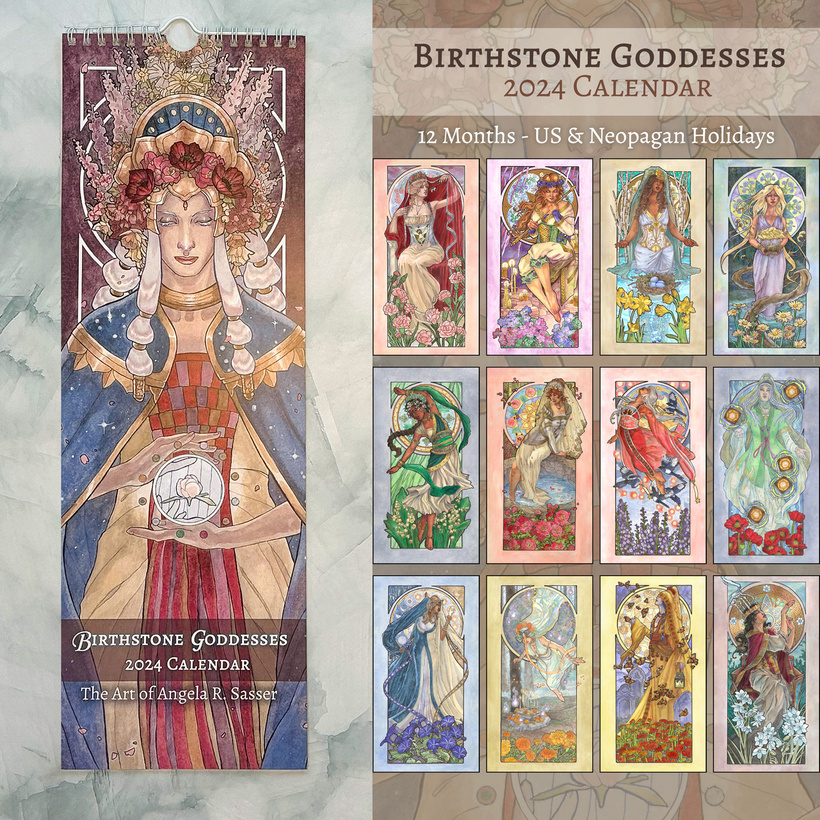
Unveiling the Birthstone Goddesses 2024 Calendar!

This collection has been years in the making and after hours of inking, painting, and toil, I have finally completed “The Final Goddess”, the 13th Goddess in the Birthstone Goddesses series!

The turning of the year ends. The cycle begins anew. Her delicate touch brings the frost. Her delicate touch brings the first blooms. Birth, Death, Grief, Healing. Turn, turn, turn.

She is all of these Goddesses and none, the Lady of Eternity, The First and Final Goddess.

I’m so pleased to introduce the calendar!  There were many unforseen challenges along the way, from a pandemic to printing woes, but with the help of new technologies in print on demand, I’m able to bring these calendars directly to you all from a printing partner!

Where to get a Calendar

  • The calendar is available in my Etsy shop here.

  • You can also find a print of the cover here.

Journey of Creation

If you missed the Behind the Scenes look at the calendar’s journey of creation I wrote for Patrons, be sure to catch up here:

“The Final Goddess” Original Painting

Watch a timelapse of this painting’s creation here. That’s 10+ hours of work condensed into 1 minute!  I hope to upload a longer narrated version of this painting and the others in the Birthstone Goddesses slowly, but surely, as they take a lot of time to edit and record.

The cover painting was created with india ink pens and watercolor with accents of white gel pen and measures 8×20 inches.  The original is available for any interested parties!  I’ll be accepting offers from Patrons for a week (till Fri. Nov 10th) before she goes live in my Fine Art shop for the general public.

She can be yours for $2700 unmatted or have me choose a mat, frame, and proper glass for her for $3240, with free shipping within the US and Canada. Patrons will also be eligible to use their 15%-25% discounts on this original as well! The discount is dependent on what tier you’re supporting at.

If interested in adding this painting to your collection, drop me a private message here via Patreon.

Help Support the Calendar!

As this calendar is a homegrown project, your word of mouth really helps me out!  Please feel free to share these social media posts and help spread the word about my calendar.  The biggest time to share is now, since the calendar will be less in-demand once 2024 begins:

—-

This has been quite the journey and I’m still reeling being at this bittersweet end!  I’ve prepared a retrospective look at all of the work I’ve created for the Birthstone Goddesses over the years for the next post that will go live next week. It’s been a joy to look back at all my favorites, especially as it’s easy to forget everything I’ve made after this long, ha!  It has been a flurry of artistic creation.

Till then, it is time for much-needed rest and celebration!

I hope you all had a lovely Halloween and that this calendar will be a light of beauty and inspiration throughout your 2024.

– Ang

The Birthstone Goddesses Collection, A Retrospective + Future of the Project?

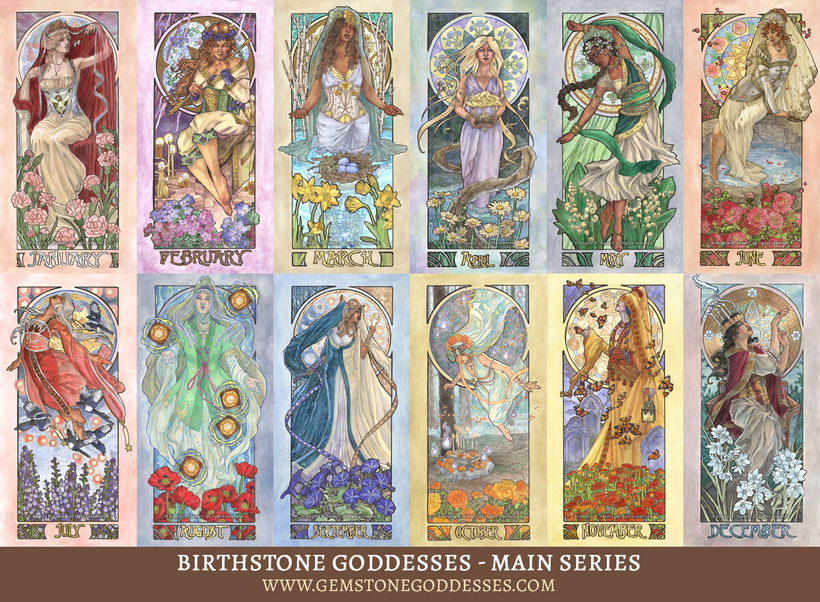
It’s the end of an era for me with the Birthstone Goddesses wrapping up!  I thought it only proper to send the project off with a look back at how it evolved over the years I spent on it.  This journey started as a simple set of 12 paintings for a calendar and ended up being so much more!

The Birthstone Goddesses

These paintings started it all!  Lady of December was the original first entry into the series in 2014 as a gift to my mother inspired by Alphonse Mucha’s Precious Stones series.  A couple of years later, the idea to continue with a series of similar paintings came to me.

The Birthstone Goddesses Masquerade

At the start of the series, I was also invested in leathercrafting as a hobby and wanted to explore the themes of flowers and birthstones via masks as well.  Each one of these is a limited edition of 10 per mask, some adorned with crystals and all hand-tooled and painted.  With the way the movement of Art Nouveau also extends beyond 2D art into jewelry, textiles, etc., I found masks to be a poetic addition to the Birthstone Goddesses’ growing ouevre.  (There are still a few masks left in my Artisan shop for anyone seeking a unique cosplay or display piece.)

(The masks were photographed by the talented Winter Wolf Studios).

The Visage Collection

Over the course of creating the paintings, I also started thinking about the prospect of creating a book, which I thought would look lovely if I started each section with a thematic banner of each Goddess.  And thus the Visage collection was born! Inspired by the gorgeous hand mirrors and cameo necklaaces from the Art Nouveau movement.

The Enamel Pin Designs

Once again, I was tempted to explore more wearable art forms by enamel pins, which I also thought would make a beautiful collectible item that would work with Goddess-themed gift sets.  The form of these pins were inspired by the cameo jewelry of Art Nouveau.  These designs were also used for stickers.

Ink & Gold Drawings

These drawings were created to promote the enamel pin designs as luxury tiers for the pins’ Kickstarters, stripping down the pin designs into elegant ink and gold.

Embellished Mats

I created these hand-drawn mats accented with gold leaf especially for display at cons. Several of them were sold before I had a chance to photograph them, as I created the full set of 12, one for each Lady.

The Little Gem Goddesses

During the coloring book’s Kickstarter, one of the stretch goals was the fun idea to do chibi versions of the Birthstone Goddesses.  Luckily they were unlocked and thus the Little Gems were born!  They’re a fun addition to this otherwise very serious series.

The Fashion Illustrations

Each Goddess’ painting was meticulously researched, planned, and rendered, including a fashion sketch on a croquis form to sort out the Goddess’ visual themes and dress.  All of these originals are still available in my shop with the exception of Lady of January’s sketch.

The Goddesses’ Windows

Each painting in the series also called for thematic mandala designs for their ‘windows’ that appear behind their heads in the main series’ paintings.  At some point, I’d like to do more with these designs to let the non-figural designs shine in all their intricate elegance.

Birthstone Goddesses Amulets

These designs were made as stickers for my Patreon Patrons, as well as what I hope will be enamel amulet necklaces I’ll be crowdfunding in the future.

Books & Misc

At the beginning of this journey, it was always my intent to create a wall calendar.  A coloring book and Lady of Eternity themed products arrived later as Patreon exclusives.  The Lady of Eternity enamel pin based on the drawing on the limited edition print is still an exclusive badge of honor for those Patrons who supported this series early on.

The Final Tally

125 creations, not including unique designs re-arranged for product designs like totes, pouches, etc.

  • 14 Paintings

  • 72 Drawings

  • 25 Pin and Amulet Designs

  • 12 Mask Designs

  • 6 Kickstarter projects

  • 1 book

  • 1 calendar

The Future of the Goddesses?

While I’m wrapping up the Birthstone Goddesses collection for now, it was always my intent that I could return to the wider Gemstone Goddesses theme and explore other gem-related Goddesses.  It’d be a chance for me to break away from the Mucha style and try other visual approaches.  I also feel that I have a few more ideas for additional paintings involving some of the Birthstone Goddess characters that I’d love to include in a prospective Birthstone Goddesses art book collecting all of the images you see here.

However, after 6 years, I desperately need some space before I take on creating a book collection for them.  I want to allow myself some creative freedom and a chance to thoroughly rest before I try anything else.

It’s strange to think what’s happened in my life during this 6 year span as well. I’ve gotten married, moved 4 times, helped my husband through his fight with lymphoma, heart failure, and job loss, had several surgeries, and so much more.  Life has been coming at us sideways for so long, I’m happy to be at an ending now that I can savor and appreciate!

It’s been quite the journey and I’m so grateful for those who provided encouragement and support along the way!  Thanks to everyone who pitched into my Patreon, supported my Kickstarters for this project, and left a kind word of encouragement in the years I’ve been doing this.  It helped my husband and I survive during rough times, as well as let me focus more on the art that helped the Birthstone Goddesses happen.

This entry is already long enough, so I’m going to leave off here!  I have some thoughts and feelings about the future of this Patreon and what art I’ll be sharing here that I’ll discuss in a later entry.  For now, let us bask and enjoy this moment of accomplishment!

– Ang
New Art! Cult of the Lamb

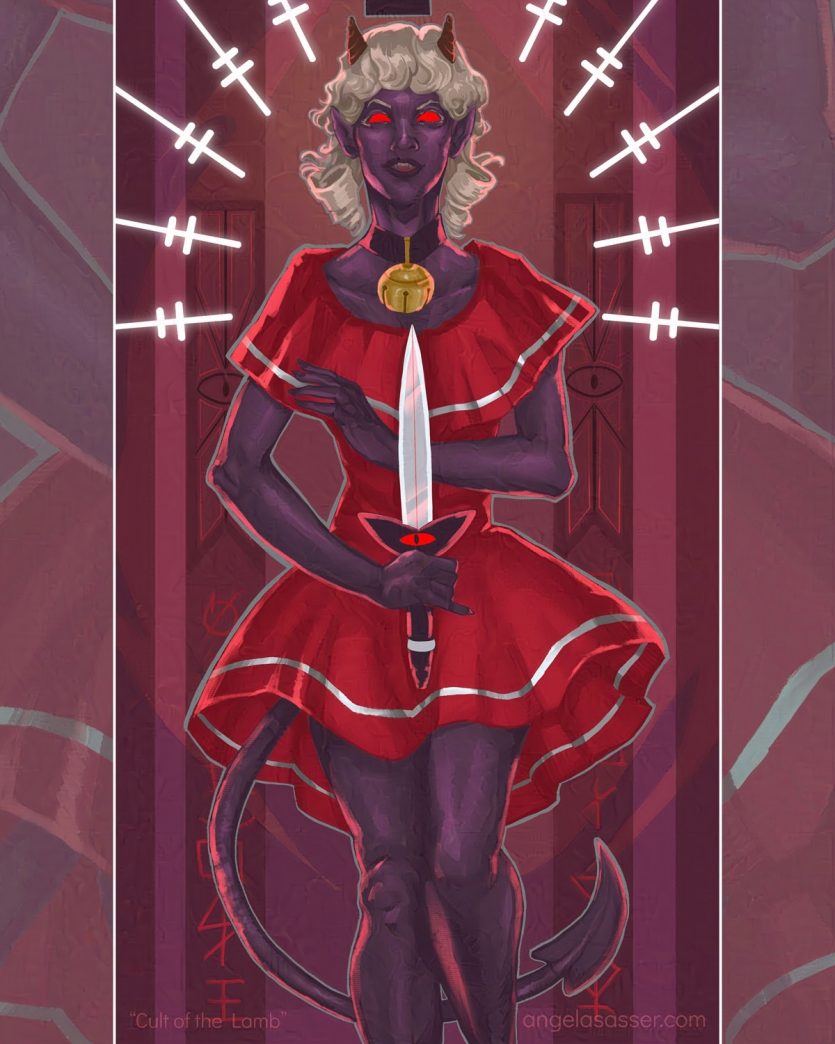
The Tiefling known now only as “The Lamb” rose from her would-be death as a sacrifice to become a Warlock of an Ancient One set on a quest for revenge for her slaying!

Or she would if I took the story of the adorably evil video game, Cult of the Lamb, and combined it with Dungeons & Dragons, which was the first thing my geek brain did when I played the game.  I enjoyed the straightforward story for the game’s premise so much, alongside all of the mechanics.  I had never played anything quite like it before!

According to my husband, I made quite a terrifying Lamb. Mua ha ha ha!

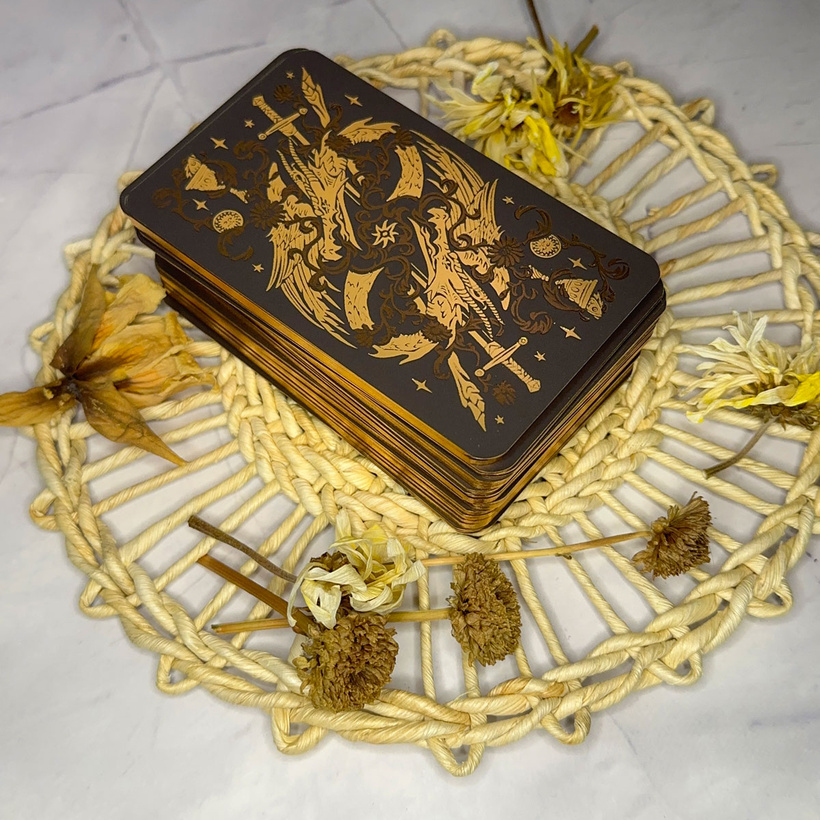
This was just a fun, silly mashup idea that came to me when I first played this game that made for excellent art practice.  Also a hint of the kind of art I’m moving towards, as it was also an experiment in nurturing a more painterly dark style inspired by Tarot (specifically the Klimt-esque aesthetic brought to the Dragon Age Tarot cards).

Hope you all enjoy my quirky little style experiment!  Painted in Procreate.

—-

  • Watch a 1 min timelapse for this piece here.

If y’all feel like supporting this art on social media, you can find this piece at the links.  Every share gives an artist wings!

A Big Career Shakeup + Where to Find Me Online

I haven’t been as active online as I used to be and I wanted to discuss that with you all here.  This year started with medical challenges and a house move which set me back a good deal.  Alongside all of that life chaos came a lot of external change in the world at the same time.  Generative AI arrived en masse and it’s given artists like myself a lot to contend with.

In a short span, I’ve found the entirety of my art from DeviantART and ArtStation fed into generative AI databases without my consent.  I’ve seen cover art, card deck illustrations, and TTRPG resources created by AI instead of hiring artists.  It all adds up to my conclusion that even if generative AI becomes ethically sourced, my prospects as an artist have (and will) drastically shrink as time goes on.

I haven’t been as active because I have been reconsidering everything about my career and whether being an illustrator was viable anymore.  It’s been a time of mourning and, frankly, paralyzing depression, as social media platforms fall apart around me at the same time, the reach and communities I lovingly built for years crumble due to ownership changes and the embracing of unregulated tech.

Thankfully, it’s not all doom and gloom.  My husband and I have been blessed with the help of Patreon and my husband’s work that now allows me to be choosier about my jobs and that has led me to my current decision to pursue projects that only align with my personal tastes and to focus mainly on my own personal projects from here on out.  It’s taken years to gain this freedom and honestly that’s been overwhelming as well!

I’ve wanted to be a lot of things in my time. Illustrator, comic artist, concept artist, etc.  There have always been a million tempting paths.  With my own mortality hovering so much over my head lately, I want to dedicate the rest of my life to telling those stories that live inside me that only I can tell while I still have time to do so.  Now, it’s a matter of wrapping up old projects and forging ahead with the new!  I’m currently preparing for all that positive change, which I’ll talk more about later.

Where to Find Me on Social Media

With all the aforementioned chaos, I’ve left many social media platforms and art communities that plan to use my art for AI training without my consent or that have changed for the worse and I wanted to keep you all up to date about where to find me.

Find me now on:

  • BlueSky instead of Twitter/X – If you need an invite, let me know and I can most likely pass you a code when I get new ones each week!  You can still find all of my art brand accounts on Twitter for now, but as soon as BlueSky comes out of beta, I’ll be leaving Twitter permanently.

  • Instagram / Facebook – I’m still on Meta platforms for now, as it is one of my oldest communities, but their plan to train their own AI on user posts worries me. Currently, I’m hoping they will clarify their uses of my art more adequately or I may be looking for an alternative for these platforms as well or leaving them entirely for Discord, but that big decision’s a ways off yet since FB is still very core to my art biz.

  • Discord – This has become where I spend the most time lately!  I frequently hangout on my personal art server, which is open to all of my fans, with a special private section for Patreon Patrons.  If you aren’t already connected through Patreon where you can claim your Patreon server role, you can join as a regular member with this invite.

    I also curate a Video Game server and an Exalted RPG Artists server, so feel free to join up and hang out there as well!

Where to Find Me on Art Communities

I’ve also had to leave places like ArtStation and DeviantART, my main haunts for going on 20 years now, for other sites that are more staunchly against unethical AI.  This has been another blow losing the communities I felt a part of for years, but I’m hopeful we can all make new connections and rebuild in these new, more supportive spaces!

Cara.app – A replacement for ArtStation with a lot of amazing artists from the game and TTRPG industry there.

Inkblot – A replacement for DeviantART showcasing lots of different media, from art to comics and more.

—-

Have any of you found new interesting places to be online?  Tell me about it!  I’m currently looking for new places to be that are more supportive of artists with strong anti-AI stances.

—-

That was a LOT, but it feels good to all these thoughts out somewhere.  Thanks for sticking with me through all of my chaos lately.  The advantage of having to start over in new places is that I can celebrate my new work and rebuild myself more efficiently, which is proving to be exciting!  With my long-term projects wrapping up after the Goddess calendar, I am very keen to show you all what I’ve been plotting in the meanwhile.

Stay strong, arty friends!  See you folks around the interwebs.

♥ Ang

Inspiration Trip: Japanese Armor Exhibit

My husband and I have been quite the hermits since COVID, so it was a big deal for us to actually leave the house this past Friday and venture forth into downtown Atlanta to the High Museum of Art, my old stomping ground where I attended SCAD-Atlanta for grad school!  The area has changed a lot, including the addition of the amazing SCAD Fashion museum and an expanded campus.

Our goal this trip was to visit the Samurai: Armor from the Collection of Ann and Gabriel Barbier-Mueller being hosted by the High.  When you first enter the exhibition space, you’re enveloped by the sound of a heartbeat as you survey a wall collaged with famous movie posters and screenshots inspired by samurai epics, including everything from Kill Bill to Kurosawa’s best.  

Past this point, many armor sets are displayed in cases that allow you to fully circumvent them, a fact I appreciated as an artist who considers drawing armor a weak point.  I especially wanted to study how armor works during this trip, but I left the exhibit with so much more inspiration than that!

My Favorite Pieces

Beyond the more traditional armor, the collection housed many impressive pieces with unique imagery, specifically Buddhist dieties and symbols, seashells, and even ‘human head’ caps.  Here are a few of my favorite pieces from the collection:

This helm sports the wheel representing the Eightfold Path of Buddhism.

A most impressive display of fully armored group of horses and riders takes up a large stage in the exhibit.  I can only imagine how horrifying and awe-inspiring they would be riding atop small ‘dragons’!

This piece caught my eye because of its striking color and unique shape.  It’s described as being a cape made for a woman, as well as a fire fighter, the long treated cloth providing protection against flames.  Fire was a major danger in Japanese fuedal cities due to the fact a large part of their construction was made of wood.  I want to know more about these female fire fighters who protected the city from threats!

All in the Details

One thing this exhibit stressed was that Samurai armor emphasized not only function, but form and aesthetics.  Even as the construction of later armor was simplified for quick dressing, the craftsmen always made sure it was beautiful and impressive.  I had to feature some of the close-up shots of the details in the metalwork and lacquered leather.

(Notice this armor has butterfly-shaped hinges to match its butterfly mon (sigil), which was the symbol of the clan being represented by this armor.)

(I especially appreciated the naturalistic motifs and stylization here.  I can see how Art Nouveau borrowed from Japanese motifs looking at this!)

Yasuke, the Black Samurai

This exhibit also included a fascinating sub-exhibit dedicated to Yasuke, an African samurai who served Nobunaga, (for those who aren’t already familiar) that’s worth a look.  The museum hired local artist, Brandon Sadler, to tell the story of Yasuke’s life through four Japanese brush style wall scrolls and they are very inspiring!

History, Worldbuilding, & Inspiration

I hope as an artist that I’ll be able to absorb something of how and why this armor operates in our world for my own worldbuilding and storytelling efforts, as many of my own stories take place in a low tech era of warfare.  Some observations I made as I absorbed this exhibit:

  • The artistry of making these armor sets represented vigilance, grace, dedication, and skillfulness on behalf of both artisan and wearer, putting an emphasis on discipline and status.

  • Visual motifs from the observed world include bamboo leaves, religious iconography, local gods and spirits, sea shells, and even smoking pipes popularized by Europeans who brought tobacco into Japan.  I imagine these motifs were chosen based on each warrior’s local symbolism, which usually shows up in the mon (family crest) too.

  • Construction elements include metal (specifically iron), silk (layered into strands and used for ties), and lacquered leather.  Swords had manta-ray skin for the grips, materials all plentiful in Japan’s island climes.  

  • Evolution of construction evolved over time based on what the armor needed to defend against. The layers were silk and layered leather or metal at first to defend against swords and arrows and protect horseback riders (needed to be light to be quick and also longer blades to reach opponents), but as time progressed, larger strips were used in chest armor to defend against matchlock weapons.  Hinges were also added to make the armor easier to get in and out of. However, none of these pieces lost their attention to detail and pageantry during that evolution.

  • The world is interconnected.  Some of the armor was inspired by European soldiers featuring paneled construction like European helmets or big noses that mocked Europeans as “demons”. Other sets were made by Korean artisans who brought their own silhouettes and techniques into Japanese armor-making during political exchanges where the armor was brought as gifts during a time of diplomacy between the two countries who have had rough history (IE. Japanese occupiation of Korea).

Full Reference Album

There are too many beautiful things to include in one blog post, so definitely check out the full album on imgur to see the rest of the pics I took and the High’s page on the exhibition, which includes additional information and history about the exhibit’s signature pieces.  I photographed with texture, construction, etc in mind for my reference as an artist.

All the photos in the world can’t do this exhibit justice, however.  These pieces are a sight to behold with so much detail to take in and I encourage you to go visit them in-person, if you can!  This exhibit will be at the High Museum until September 17th.

—-

There were also lots of wonderful Japanese reference books, comics, and souvenirs featured in the gift shop.  I left with a couple of small souvenirs for myself, including a magnet, which I always get for any exhibit we attend.  A butterfly-themed pin seemed appropriate after marveling at the buttefly-themed armor set I particularly enjoyed!  We also purchased the #4 print in the Yasuke set for our personal collection, as he is an inspiring figure for my husband, Kevin.

I hope to explore more exhibits like this as long as we’re in the vicinity of so many wonderful museums!  Seeing this beautiful artistry in an amazing collection filled me with such awe I hope to channel into aspects of my own work.  I hope you all are inspired as well!

♥ Ang

Inspiration Trip: Japanese Armor Exhibit

My husband and I have been quite the hermits since COVID, so it was a big deal for us to actually leave the house this past Friday and venture forth into downtown Atlanta to the High Museum of Art, my old stomping ground where I attended SCAD-Atlanta for grad school!  The area has changed a lot, including the addition of the amazing SCAD Fashion museum and an expanded campus.

Our goal this trip was to visit the Samurai: Armor from the Collection of Ann and Gabriel Barbier-Mueller being hosted by the High.  When you first enter the exhibition space, you’re enveloped by the sound of a heartbeat as you survey a wall collaged with famous movie posters and screenshots inspired by samurai epics, including everything from Kill Bill to Kurosawa’s best.  

Past this point, many armor sets are displayed in cases that allow you to fully circumvent them, a fact I appreciated as an artist who considers drawing armor a weak point.  I especially wanted to study how armor works during this trip, but I left the exhibit with so much more inspiration than that!

My Favorite Pieces

Beyond the more traditional armor, the collection housed many impressive pieces with unique imagery, specifically Buddhist dieties and symbols, seashells, and even ‘human head’ caps.  Here are a few of my favorite pieces from the collection:

This helm sports the wheel representing the Eightfold Path of Buddhism.

A most impressive display of fully armored group of horses and riders takes up a large stage in the exhibit.  I can only imagine how horrifying and awe-inspiring they would be riding atop small ‘dragons’!

This piece caught my eye because of its striking color and unique shape.  It’s described as being a cape made for a woman, as well as a fire fighter, the long treated cloth providing protection against flames.  Fire was a major danger in Japanese fuedal cities due to the fact a large part of their construction was made of wood.  I want to know more about these female fire fighters who protected the city from threats!

All in the Details

One thing this exhibit stressed was that Samurai armor emphasized not only function, but form and aesthetics.  Even as the construction of later armor was simplified for quick dressing, the craftsmen always made sure it was beautiful and impressive.  I had to feature some of the close-up shots of the details in the metalwork and lacquered leather.

(Notice this armor has butterfly-shaped hinges to match its butterfly mon (sigil), which was the symbol of the clan being represented by this armor.)

(I especially appreciated the naturalistic motifs and stylization here.  I can see how Art Nouveau borrowed from Japanese motifs looking at this!)

Yasuke, the Black Samurai

This exhibit also included a fascinating sub-exhibit dedicated to Yasuke, an African samurai who served Nobunaga, (for those who aren’t already familiar) that’s worth a look.  The museum hired local artist, Brandon Sadler, to tell the story of Yasuke’s life through four Japanese brush style wall scrolls and they are very inspiring!

History, Worldbuilding, & Inspiration

I hope as an artist that I’ll be able to absorb something of how and why this armor operates in our world for my own worldbuilding and storytelling efforts, as many of my own stories take place in a low tech era of warfare.  Some observations I made as I absorbed this exhibit:

  • The artistry of making these armor sets represented vigilance, grace, dedication, and skillfulness on behalf of both artisan and wearer, putting an emphasis on discipline and status.

  • Visual motifs from the observed world include bamboo leaves, religious iconography, local gods and spirits, sea shells, and even smoking pipes popularized by Europeans who brought tobacco into Japan.  I imagine these motifs were chosen based on each warrior’s local symbolism, which usually shows up in the mon (family crest) too.

  • Construction elements include metal (specifically iron), silk (layered into strands and used for ties), and lacquered leather.  Swords had manta-ray skin for the grips, materials all plentiful in Japan’s island climes.  

  • Evolution of construction evolved over time based on what the armor needed to defend against. The layers were silk and layered leather or metal at first to defend against swords and arrows and protect horseback riders (needed to be light to be quick and also longer blades to reach opponents), but as time progressed, larger strips were used in chest armor to defend against matchlock weapons.  Hinges were also added to make the armor easier to get in and out of. However, none of these pieces lost their attention to detail and pageantry during that evolution.

  • The world is interconnected.  Some of the armor was inspired by European soldiers featuring paneled construction like European helmets or big noses that mocked Europeans as “demons”. Other sets were made by Korean artisans who brought their own silhouettes and techniques into Japanese armor-making during political exchanges where the armor was brought as gifts during a time of diplomacy between the two countries who have had rough history (IE. Japanese occupiation of Korea).

Full Reference Album

There are too many beautiful things to include in one blog post, so definitely check out the full album on imgur to see the rest of the pics I took and the High’s page on the exhibition, which includes additional information and history about the exhibit’s signature pieces.  I photographed with texture, construction, etc in mind for my reference as an artist.

All the photos in the world can’t do this exhibit justice, however.  These pieces are a sight to behold with so much detail to take in and I encourage you to go visit them in-person, if you can!  This exhibit will be at the High Museum until September 17th.

—-

There were also lots of wonderful Japanese reference books, comics, and souvenirs featured in the gift shop.  I left with a couple of small souvenirs for myself, including a magnet, which I always get for any exhibit we attend.  A butterfly-themed pin seemed appropriate after marveling at the buttefly-themed armor set I particularly enjoyed!  We also purchased the #4 print in the Yasuke set for our personal collection, as he is an inspiring figure for my husband, Kevin.

I hope to explore more exhibits like this as long as we’re in the vicinity of so many wonderful museums!  Seeing this beautiful artistry in an amazing collection filled me with such awe I hope to channel into aspects of my own work.  I hope you all are inspired as well!

♥ Ang

Inspiration Trip: Japanese Armor Exhibit

My husband and I have been quite the hermits since COVID, so it was a big deal for us to actually leave the house this past Friday and venture forth into downtown Atlanta to the High Museum of Art, my old stomping ground where I attended SCAD-Atlanta for grad school!  The area has changed a lot, including the addition of the amazing SCAD Fashion museum and an expanded campus.

Our goal this trip was to visit the Samurai: Armor from the Collection of Ann and Gabriel Barbier-Mueller being hosted by the High.  When you first enter the exhibition space, you’re enveloped by the sound of a heartbeat as you survey a wall collaged with famous movie posters and screenshots inspired by samurai epics, including everything from Kill Bill to Kurosawa’s best.  

Past this point, many armor sets are displayed in cases that allow you to fully circumvent them, a fact I appreciated as an artist who considers drawing armor a weak point.  I especially wanted to study how armor works during this trip, but I left the exhibit with so much more inspiration than that!

My Favorite Pieces

Beyond the more traditional armor, the collection housed many impressive pieces with unique imagery, specifically Buddhist dieties and symbols, seashells, and even ‘human head’ caps.  Here are a few of my favorite pieces from the collection:

This helm sports the wheel representing the Eightfold Path of Buddhism.

A most impressive display of fully armored group of horses and riders takes up a large stage in the exhibit.  I can only imagine how horrifying and awe-inspiring they would be riding atop small ‘dragons’!

This piece caught my eye because of its striking color and unique shape.  It’s described as being a cape made for a woman, as well as a fire fighter, the long treated cloth providing protection against flames.  Fire was a major danger in Japanese fuedal cities due to the fact a large part of their construction was made of wood.  I want to know more about these female fire fighters who protected the city from threats!

All in the Details

One thing this exhibit stressed was that Samurai armor emphasized not only function, but form and aesthetics.  Even as the construction of later armor was simplified for quick dressing, the craftsmen always made sure it was beautiful and impressive.  I had to feature some of the close-up shots of the details in the metalwork and lacquered leather.

(Notice this armor has butterfly-shaped hinges to match its butterfly mon (sigil), which was the symbol of the clan being represented by this armor.)

(I especially appreciated the naturalistic motifs and stylization here.  I can see how Art Nouveau borrowed from Japanese motifs looking at this!)

Yasuke, the Black Samurai

This exhibit also included a fascinating sub-exhibit dedicated to Yasuke, an African samurai who served Nobunaga, (for those who aren’t already familiar) that’s worth a look.  The museum hired local artist, Brandon Sadler, to tell the story of Yasuke’s life through four Japanese brush style wall scrolls and they are very inspiring!

History, Worldbuilding, & Inspiration

I hope as an artist that I’ll be able to absorb something of how and why this armor operates in our world for my own worldbuilding and storytelling efforts, as many of my own stories take place in a low tech era of warfare.  Some observations I made as I absorbed this exhibit:

  • The artistry of making these armor sets represented vigilance, grace, dedication, and skillfulness on behalf of both artisan and wearer, putting an emphasis on discipline and status.

  • Visual motifs from the observed world include bamboo leaves, religious iconography, local gods and spirits, sea shells, and even smoking pipes popularized by Europeans who brought tobacco into Japan.  I imagine these motifs were chosen based on each warrior’s local symbolism, which usually shows up in the mon (family crest) too.

  • Construction elements include metal (specifically iron), silk (layered into strands and used for ties), and lacquered leather.  Swords had manta-ray skin for the grips, materials all plentiful in Japan’s island climes.  

  • Evolution of construction evolved over time based on what the armor needed to defend against. The layers were silk and layered leather or metal at first to defend against swords and arrows and protect horseback riders (needed to be light to be quick and also longer blades to reach opponents), but as time progressed, larger strips were used in chest armor to defend against matchlock weapons.  Hinges were also added to make the armor easier to get in and out of. However, none of these pieces lost their attention to detail and pageantry during that evolution.

  • The world is interconnected.  Some of the armor was inspired by European soldiers featuring paneled construction like European helmets or big noses that mocked Europeans as “demons”. Other sets were made by Korean artisans who brought their own silhouettes and techniques into Japanese armor-making during political exchanges where the armor was brought as gifts during a time of diplomacy between the two countries who have had rough history (IE. Japanese occupiation of Korea).

Full Reference Album

There are too many beautiful things to include in one blog post, so definitely check out the full album on imgur to see the rest of the pics I took and the High’s page on the exhibition, which includes additional information and history about the exhibit’s signature pieces.  I photographed with texture, construction, etc in mind for my reference as an artist.

All the photos in the world can’t do this exhibit justice, however.  These pieces are a sight to behold with so much detail to take in and I encourage you to go visit them in-person, if you can!  This exhibit will be at the High Museum until September 17th.

—-

There were also lots of wonderful Japanese reference books, comics, and souvenirs featured in the gift shop.  I left with a couple of small souvenirs for myself, including a magnet, which I always get for any exhibit we attend.  A butterfly-themed pin seemed appropriate after marveling at the buttefly-themed armor set I particularly enjoyed!  We also purchased the #4 print in the Yasuke set for our personal collection, as he is an inspiring figure for my husband, Kevin.

I hope to explore more exhibits like this as long as we’re in the vicinity of so many wonderful museums!  Seeing this beautiful artistry in an amazing collection filled me with such awe I hope to channel into aspects of my own work.  I hope you all are inspired as well!

♥ Ang

Inspiration Trip: Japanese Armor Exhibit

My husband and I have been quite the hermits since COVID, so it was a big deal for us to actually leave the house this past Friday and venture forth into downtown Atlanta to the High Museum of Art, my old stomping ground where I attended SCAD-Atlanta for grad school!  The area has changed a lot, including the addition of the amazing SCAD Fashion museum and an expanded campus.

Our goal this trip was to visit the Samurai: Armor from the Collection of Ann and Gabriel Barbier-Mueller being hosted by the High.  When you first enter the exhibition space, you’re enveloped by the sound of a heartbeat as you survey a wall collaged with famous movie posters and screenshots inspired by samurai epics, including everything from Kill Bill to Kurosawa’s best.  

Past this point, many armor sets are displayed in cases that allow you to fully circumvent them, a fact I appreciated as an artist who considers drawing armor a weak point.  I especially wanted to study how armor works during this trip, but I left the exhibit with so much more inspiration than that!

My Favorite Pieces

Beyond the more traditional armor, the collection housed many impressive pieces with unique imagery, specifically Buddhist dieties and symbols, seashells, and even ‘human head’ caps.  Here are a few of my favorite pieces from the collection:

This helm sports the wheel representing the Eightfold Path of Buddhism.

A most impressive display of fully armored group of horses and riders takes up a large stage in the exhibit.  I can only imagine how horrifying and awe-inspiring they would be riding atop small ‘dragons’!

This piece caught my eye because of its striking color and unique shape.  It’s described as being a cape made for a woman, as well as a fire fighter, the long treated cloth providing protection against flames.  Fire was a major danger in Japanese fuedal cities due to the fact a large part of their construction was made of wood.  I want to know more about these female fire fighters who protected the city from threats!

All in the Details

One thing this exhibit stressed was that Samurai armor emphasized not only function, but form and aesthetics.  Even as the construction of later armor was simplified for quick dressing, the craftsmen always made sure it was beautiful and impressive.  I had to feature some of the close-up shots of the details in the metalwork and lacquered leather.

(Notice this armor has butterfly-shaped hinges to match its butterfly mon (sigil), which was the symbol of the clan being represented by this armor.)

(I especially appreciated the naturalistic motifs and stylization here.  I can see how Art Nouveau borrowed from Japanese motifs looking at this!)

Yasuke, the Black Samurai

This exhibit also included a fascinating sub-exhibit dedicated to Yasuke, an African samurai who served Nobunaga, (for those who aren’t already familiar) that’s worth a look.  The museum hired local artist, Brandon Sadler, to tell the story of Yasuke’s life through four Japanese brush style wall scrolls and they are very inspiring!

History, Worldbuilding, & Inspiration

I hope as an artist that I’ll be able to absorb something of how and why this armor operates in our world for my own worldbuilding and storytelling efforts, as many of my own stories take place in a low tech era of warfare.  Some observations I made as I absorbed this exhibit:

  • The artistry of making these armor sets represented vigilance, grace, dedication, and skillfulness on behalf of both artisan and wearer, putting an emphasis on discipline and status.

  • Visual motifs from the observed world include bamboo leaves, religious iconography, local gods and spirits, sea shells, and even smoking pipes popularized by Europeans who brought tobacco into Japan.  I imagine these motifs were chosen based on each warrior’s local symbolism, which usually shows up in the mon (family crest) too.

  • Construction elements include metal (specifically iron), silk (layered into strands and used for ties), and lacquered leather.  Swords had manta-ray skin for the grips, materials all plentiful in Japan’s island climes.  

  • Evolution of construction evolved over time based on what the armor needed to defend against. The layers were silk and layered leather or metal at first to defend against swords and arrows and protect horseback riders (needed to be light to be quick and also longer blades to reach opponents), but as time progressed, larger strips were used in chest armor to defend against matchlock weapons.  Hinges were also added to make the armor easier to get in and out of. However, none of these pieces lost their attention to detail and pageantry during that evolution.

  • The world is interconnected.  Some of the armor was inspired by European soldiers featuring paneled construction like European helmets or big noses that mocked Europeans as “demons”. Other sets were made by Korean artisans who brought their own silhouettes and techniques into Japanese armor-making during political exchanges where the armor was brought as gifts during a time of diplomacy between the two countries who have had rough history (IE. Japanese occupiation of Korea).

Full Reference Album

There are too many beautiful things to include in one blog post, so definitely check out the full album on imgur to see the rest of the pics I took and the High’s page on the exhibition, which includes additional information and history about the exhibit’s signature pieces.  I photographed with texture, construction, etc in mind for my reference as an artist.

All the photos in the world can’t do this exhibit justice, however.  These pieces are a sight to behold with so much detail to take in and I encourage you to go visit them in-person, if you can!  This exhibit will be at the High Museum until September 17th.

—-

There were also lots of wonderful Japanese reference books, comics, and souvenirs featured in the gift shop.  I left with a couple of small souvenirs for myself, including a magnet, which I always get for any exhibit we attend.  A butterfly-themed pin seemed appropriate after marveling at the buttefly-themed armor set I particularly enjoyed!  We also purchased the #4 print in the Yasuke set for our personal collection, as he is an inspiring figure for my husband, Kevin.

I hope to explore more exhibits like this as long as we’re in the vicinity of so many wonderful museums!  Seeing this beautiful artistry in an amazing collection filled me with such awe I hope to channel into aspects of my own work.  I hope you all are inspired as well!

♥ Ang