Author: Angela S.

Confessions of an Artist Part 4

On the last “Confessions” post, we talked about the merits and downfalls of tracing. Many of you revealed that I am not the only one to start out in art with early tracing books. It was also interesting to hear about how I am not the only one to suffer Dragonball and Sailor Moon anime influenced phases. I do wonder sometimes what the next influential phase of infectious art styles will be for the future generations of artists? Perhaps Avatar: The Last Airbender, Naruto, or Inuyasha styles?

This week I’d like to make yet another confession.

I have only in recent years learned that piling artwork under my bed is not the best practice for storing original art. Even worse, there was a point during my high school days where I was storing art with….cardboard and plastic wrap. Yes, the plastic wrap from your kitchen. (Don’t try this at home, kiddies!)

Oh sure, it is easy when we start out to believe that art is just for fun, so why not toss it under the bed or on the next most convenient pile on your desk? It will be fine until we dig it out again, right? Eventually, we graduate to stuffing them in trapper keepers and accrue piles of shiny notebooks, folders, and trapper keepers with papers sticking out of them. Things like pH balance don’t exist for us when we’re young and naive and, like our art, we view ourselves as immortal. The art will always be there when we need it.

I learned my lesson the hard way when I went to dig out old work, seeking something to display for a student show, and found that most of my work was yellow, stained with cat puke, or torn and ripped at the corners. Lesson being, don’t store your art under your bed if you can help it. So, I’m here to implore you to please, as early as possible, form good storage habits for art if it really means something to you.

Some basic things to remember for storing your art properly:

  • Paper, especially newsprint, is prone to yellowing. Store it out of the sun where possible. Use higher quality thicker paper like Bristol board or illustration board when you can instead of cheap drawing paper from drawing pads which is easier to damage. Drawing pads are great for practice sketches, but higher quality paper will make your masterpieces last longer.
  • Masking tape, scotch tape, and certain types of mat board contain acid, which can cause staining and yellowing. General rule of thumb: If it’s physically touching your artwork, it needs to be acid free (archival)!
  • Cardboard is NOT archival unless you special order archival backing board or cut your own backing from acid free board.
  • Certain media such as pastel, charcoal, and color pencil need to be sprayed with fixative to preserve their color and to insure that they do not rub off. Acrylics do not need to be sprayed, though they will benefit from being sealed with a protective layer of varnish. Oils, on the other hand, require a layer of varnish to set the colors.

Some simple storage solutions for your art:

  • Storage & Display Portfolios – Buy storage portfolios instead of trapper keepers. I recommend Itoya portfolios. They are fairly affordable and come in multiple sizes to suit all needs. Their pages and mounting paper are archival/acid free and the portfolios look tons more professional than your shiny hot pink Lisa Frank trapper keeper. You can also customize the spine to show your name by sliding the paper out and replacing it with your own like this.
  • Carrying Cases & Large Portfolios – Storing larger work over 14×17 inches can be problematic. If you can store them in a carrying case portfolio or keep them in their original art pad binders, that is better than piling large work loose somewhere where they are easy to damage. Another alternative is to properly mat and frame the large work and hang it up on the wall
  • Plastic Bins & Paper Copy Boxes – Storing larger framed work can be tricky. If you can’t put it on the wall, it is best to store frames upright in copy paper boxes or large plastic bins with protective styrofoam sheets or cardboard in-between. If you stack your frames with protective sheets between, just don’t stack them too high or the weight could damage the frames on the bottom. For additional protection, you may want to wrap each frame individually with bubble wrap. Most times, you can go to large stores like Sam’s, or other department stores, and get handy cardboard bins or paper copy boxes for free or low cost.
  • Plastic Storage Drawers – For storing smaller framed works and stacks of portfolios, you might want to invest in good plastic storage shelves. I prefer shelves which have closed walls as this helps to keep dust from gathering on your work. Be warned! Don’t skimp on buying good plastic shelves, as the cheap ones will bow and are only useful for storing very light objects. A general indicator of a good quality plastic storage unit is that the plastic is opaque instead of clear.
  • A Good Plastic Bin
    A Bad Plastic Bin

My Home Setup

Just about all of my supplies and materials are kept in the opaque plastic shelves on the bottom with lightweight portfolios, mailing envelopes, and small originals kept in the crappy clear drawers sitting on top of the ‘nice’ plastic shelf. I still have art piled under my bed, but it’s generally the stuff which I don’t mind being damaged or it is still snuggly attached in its original art pad.

I have tons of copy boxes and over the shoulder carrying case portfolios in my room and basement which store framed art, scraps, large art, and other supplies. My setup isn’t perfect yet, as my large canvas work still sits relatively unprotected and leaning against a wall, but it’s a start!

My final word of advice is to start storing your stuff properly as early as possible. You don’t want a possible masterpiece to be ruined by carelessness and trust me that cat puke is the most horrible permanent yellow you will ever see.

Those of you who are already practicing good habits, how do you store your art? Do you have anything to add to this list of suggestions? Feel free to share photos of your storage space!

Work at Home Blues

And so I enter the 4th or so week of working a day job as an illustrator who works at a home studio (if indeed a desk and drawers stuffed with art supplies constitute as a studio), and I’m beginning to learn the glories and downfalls of what that really means. It’s so wonderful to be at this point in my career finally, but I am finding myself growing a little odd from spending so much time alone.

I’ve started talking to paintings and humming musical renditions of Ultramarine and Alizaran Crimson. I’ve probably seen Jurassic Park six times, since that seems to be what’s showing in the background on tv whenever I work at the desk these days. Coming from previous professions that involved social interaction with students and co-workers, it’s been an interesting transition. Being able to concentrate on art has been lovely, but I find I miss the social interaction just a little.

Now I just have my dog and my paints.

Contrary to popular belief, working at home is not as simple as it seems. It is far too easy to get distracted by the shiny, shiny net and not get your work quota done for the day. Like most jobs, there are deadlines involved and if things go wrong and you’re late, it’s nobody’s fault but your own. There is no bureaucracy to blame for your own mistakes. If you’re a work-o-holic like me, you might end up working too late, like I commonly do, being the night owl that I am. I still haven’t quite found a way to balance a schedule with creating a social life. I must learn how to put the paintbrush down and to stop worrying about deadlines! For when the current deadline ends, there will (hopefully) always be yet another and another!

So I am curious, you artists, writers, or work-at-home masterminds who run your own businesses, how do you keep yourself motivated? How do you cut down on distraction? How do you balance having a social life with trying to meet quotas? How do you prevent yourself from going just a little batty from being alone?

Inquiring minds who are currently distracted by blog writing would like to know!

Ang’s Vault of Horrors: Gargoyles

…or more commonly called the pile of ages old artwork stuffed under my bed which I have never dared to share before! There was a time when I was obsessed with an old Disney cartoon series called Gargoyles. Throw faerie myths, Shakespeare, and King Arthur into a blender with modern mythologies and you have a combination for win in my book. I loved this series, and STILL love it. The animation still beats all the half-arsed cartoon series I see on tv today.

I was fascinated by the glowing eyes, proud demeanor, and aerial prowess of these gorgeous creatures and drew them ALL the time. To say that they influenced my early artistic development, both as an artist and a writer, would be an understatement.

Enjoy this peek into my early obsession with winged creatures. Many of these characters evolved from gargoyle wanna-be’s to the main characters of my obligatory never-ending fantasy epic (more on that later). Just about all of this work is from the 1990’s.

Just goes to show that we all start somewhere!

This was the very first image I did of the gargoyles sort featuring an ooold character named Nava. Done in cheap crappy marker and Precision pens! I miss those pens sometimes. Notice the crappy Photoshopped spliced photo background. I did that a lot in the old days till I learned better.

Here’s Nava and her boyfriend, Matayo. I had a thing for Spanish names and tragic couples back then. By this time, I’d finally discovered Prismacolor marker.

This one’s from middle school! Egads, the bad comic book anatomy.

This red gal here (Natalia), became my main obsession after awhile. She’s gained a few fingers since that last picture!

Natalia’s daughter, Helena. How we get blue from red is thanks to her very blue daddy. I recall drawing and coloring this particular pic entirely during a high school algebra class (and somehow still passing the class). Discovered Prismacolor Color Pencils around this point.

More evolution of Natalia and my anatomy skills. It seems I loved complicated tattoo and jewelry designs even back then. I still love her little wing arms in this one. Even they have blades!

Last one for now! This is Natalia’s red daughter, Coronada (wee more Spanish names!). She was the mean one who could use the little ribbons around her arms as weapons with moon blades on the ends. Still loving this design. I will have to do something new with it sometime!

And that’s all for this peek into my artwork chamber of horrors. Stay tuned for more as the excavation under my bed continues!

Do you all have any old work or ideas you’d like to share? I would love to see that I’m not the only one who made up strange tales of red and blue people when they were a kid.

The Need to Fly

Quickie Updates:

  • Just finished writing half of Chapter 1 of the semi-secret book project, now begins the illustrating!
  • Working on entering more shows this year, including Mobicon, Dragoncon, and San Diego Comic Con. Cross your fingers for passing dcon jury! I may have a table this year, if all goes to plan.
  • Dabbling with new tile pendants and jewelry designs (keep an eye on my jewelry sketchbook and Etsy Updates for more)
  • Working on a possible entry for the Good vs Evil contest
  • Trying to repress the project fairy so I can get work done!
  • More ramblings about angels in art…

    This weekend, I had the great pleasure of riding with Windfalcon to visit the birds of prey wildlife center at Georgia Southern University. Besides getting some wonderful reference shots of these graceful creatures, I found myself thinking on the meaning of wings. With angels on my mind lately for several projects I’m working on, I’ve been pondering the reason why so many artists and poets decided to meld these feathery appendages with the human form throughout the ages.

    What is it about the inclusion of wings that has marked these beings as divine? Perhaps the ability to fly , an unprecedented thing for early man, makes them boundless? Perhaps the untouchable beauty of watching a bird in flight inspired these artists to try and recapture that awe within the human figure? If ancient man was so fascinated by the impossible prospect of flight that they reflected this need upon angels, why, then, does modern man still find it so fascinating? We have long been capable of flight thanks to the Wright brothers, and yet, most angels are still drawn with wings.

    What might an angel look like in modern imagery if we try to reflect what we are incapable of achieving in the depiction of their form, just as ancient man did in adding wings? Instead of a fiery sword, would an archangel carry an AK-47? A dragonscale bulletproof bodysuit over a set of Roman plate mail? These days, instead of wings, most angels in modern movies and books seem to wear long black trench coats and sashay dramatically with long, gorgeous locks of hair. Even more, these seemingly pure creatures have become sensual and human in a way that has added an edgy fascination for many.

    Whatever the reason, I can personally see why early man might have chosen to give a human the grace of a bird, just from peeking into that world of birds of prey and watching these lightweight hunters float soundlessly on the air, or fly so fast they barely leave an imprint in my vision. Birds really are wondrous creatures…a pity we mainly ignore them because we’re simply too used to them being around us.

    I suppose we should thank/blame Windfalcon for this post. She bit me with her bird fever. If anyone’s interested, I’ll be posting up some of the reference footage I shot while at the raptor center at my YouTube page sometime soon once I get permission to do so.

    Until next post, enjoy this contemporary take on a classical archangel.

    Are You a Sellout?

    Every artist hears this at one point in their development. The worries of becoming what others call a ‘sell out’ enter into our artistic lives much like the recognition of what death is for children who are innocent of the pain of such knowledge.

    What is a sellout, exactly?

    According to some who are too free with the term, it can be the fan artist, the merchandising artist, the faerie artist. The term sellout is attached to many types, particularly certain genres like fantasy.

    sellĀ·out (slout)n.One who has betrayed one’s principles or an espoused cause.

    That is the dictionary definition of the slang, but I have heard this term thrown around for something as simple as drawing fan art, which is a gross misinterpretation. If you draw something like fan art, or any form of art, and enjoy it thoroughly, why should this be labeled negatively? Why should our enjoyment of art be ruined just because what we enjoy drawing happens to be popular?

    I have also heard this term thrown at artists who have reached a level of success where their art can be found in popular venues on a variety of products. Amy Brown and Thomas Kinkade are two of the more hotly debated artists considered ‘sellouts’ by many.

    Amy Brown is an artist most popularly known for the stripy socked variety of fairies which are featured on an endless amount of products, from journals to candles to stickers and beyond. The question of whether she is a sellout because she has found such a successful niche is not the important one. Rather, the question should be, does she love what she does? Even if she doesn’t, is it wrong for an artist to make money doing something in their field that’s at least more satisfying than mopping floors at the nearest grocery mart?

    Without knowing Brown personally, I cannot say whether she loves what she does or not. I will admit, I am not innocent in that I did, at one point, think of her as a sellout. I got called out on this once by my boyfriend who said “Well maybe she’s just trying to make a living? That’s harder than a lot of people realize. Maybe she hates her artwork just as much as some others do, but she’s just trying to get by. There’s nothing wrong with that.”

    No, I still do not like the gothy brand of stripy socked faeries, but coming of age as an artist trying to make it professionally has softened my heart to people I may have been too judgmental about when I had others paying my way and wasn’t trying to make a living off of my art. Who am I to tell others what to like? I’m entitled to my individual likes and dislikes as much as anyone else. Just as Amy Brown, or any artist, has a right to make a living.

    Who knows? One day people might look at my stuff and say my angel art is ‘selling out’. I know I’ve not escaped the gothy label myself. In which case, I’ll just shrug and keep drawing. Why stop doing what I enjoy doing? People are inclined to label you no matter who you are and all anyone can do is be a professional and keep going, keep seeking out inspiration, keep experimenting, especially if you feel their labels are true to any degree.

    Thomas Kinkade is another hotly debated figure. The afamed “Painter of Light” has a worldwide corporate reach for his depictions of brightly colored paintings of houses and landscapes. I have sat with many discussions with my mother, who is an avid fan of Kinkade’s, and pondered about what the appeal is. I have asked her if she thought he was a sellout for being as widespread as he is and for using studio assistants to paint in his work, and she shook her head, smiling. The enjoyment of his art had nothing to do with the process, according to my mother, who has collected miniature houses since I was young. Anybody who said differently was someone who was jealous of his success, in her eyes.

    And herein lies the difference between many of us. Most normal everyday folks are enamored by the seemingly mystical end-product of art. They recognize it for what it is to the naked eye and marvel at the artist’s skill, while others, particularly artists, get to the heart of the matter, which is the artist’s intentions behind creating the work. Does Kinkade paint houses now ONLY to sell or does he enjoy it as well? It’s impossible to tell just as it is for Brown without knowing him personally.

    Again, I still think all his houses look the same, but my mother is completely and totally in love with them, and I would never seek to deprive her of that. Kinkade is a genius in her eyes and just because I don’t like him doesn’t mean she can’t enjoy it.

    In the end, there is one thing I am certain of in this area of gray that is ‘selling out’. If you do not love what you do, it is going to show in your artwork. Art has a habit of losing that special something that we are all tuned into subconsciously when the artist becomes uninspired. Does this automatically mean you are a sellout if you keep going? Perhaps…but whose right is it to tell an artist, even an uninspired one, to stop creating and go do something else? We all go through these waxing and waning phases of inspiration and sometimes it takes a jolt of epiphany to get us back on track again.

    Now are you a sellout if you create artwork and slap it onto a thong, even though your art doesn’t really fit the products you’re putting it on? Yes, but if you can actually SELL that thong to someone who enjoys it, than more power to you! Generally, however, it’s much harder to sell a product you don’t believe in or that you are not inspired for. With the number of artists increasing every day, it is becoming harder and harder to stand out from the crowd, meaning the less inspiration you have, the less chance you’ll have to be noticed and to succeed.

    My advice is this: Throw the nay-sayers to the wind and do what you enjoy. Experiment! Have fun! Learn! Create! The next time you think about calling someone a sellout, bare this in mind:

    Are you only doing so because you’re jealous, deep down?
    Are you quite sure that they don’t love what they do?
    More importantly, is it so bad to make a living?

    Save yourself the drama and go do some art instead! Take a moment and judge yourself first before you go labeling others.

    What Moves You? Exploring Artistic Inspiration

    I remember a time when I was first learning about art that I found myself amazed at how the play of light, shadow, and emotion could be created from a simple stroke of the brush. In particular, I was drawn to the Renaissance masters and the religious art meant to teach an illiterate populace the lessons of the bible without ever having to read a word. The lesson was in the compassionate pose of the hands, the elegant sweep of hair, the blush of divine light. Artists made a living from telling epic stories meant to move the soul.

    Today, and many days previous, I find myself wondering how, as an artist, I can bring that same kind of emotion to my work. Like any mystery, it starts with the self and what affects you, personally. Have you ever found yourself staring at a piece of art? What causes you to stare at it longer than a simple glance? What grips your soul? What makes you think?

    For me, there are a few particular pieces that make me stare in awe and trigger an unnameable emotion. The first would be the painting Saint Eulalia by John William Waterhouse.


    Before I knew her story, I was fascinated by the delicacy of her skin and the gentle fall of snow. Not only was this piece visually stunning to me, but the contrast of such a violent act as the murder of a child with the soft fall of snow jarred me in some unidentifiable way. I went on to learn that Eulalia was a Christian child who taunted the Romans, and was later tortured with hooks and burnt at the stake, where she died of smoke inhalation. At the moment of death, a dove symbolizing the holy spirit flew from her mouth. A miraculous fall of white snow appeared to cover her naked form.

    The next piece is one of my all-time favorite works of art and also my favorite sculpture. I hope to one day make a pilgrimage to the Louvre to see it in person. If you don’t know it already, it is the Pieta by Michelangelo.


    Again, the subject of death, self sacrifice, and those who are left behind seems to be one that strikes me at the core. What greater pain could there be than for a mother to lose her child? And yet, there’s something endearing and brave in Mary’s gentle expression. Even in such a moment of pain, her serenity expresses nothing but pure love in the face of such sorrow.

    I could go on about Millias’ Ophelia and Waterhouse’s Lady of Shalott, but I want to hear from you. I seem to be firmly ensconced in works depicting the ecstasy and passion of martyrs. What this says about my work, I’m not quite sure yet, but it seems like I still have some exploration with subject matter to do beyond my current fair of ‘pretty things’.

    What paintings or works of art move you and why? How has this inspired your own work?

    Forsythia Walkthrough & Angelic Inspiration

    After so many serious business posts, I thought I might air out this journal with a glimpse into a walkthrough I’ve been working on lately to stretch my legs at writing instructional art direction. The first blossoms of Spring have sprung and everywhere the Forsythia have blossomed in bunches of yellow splendor. This awakening of color has inspired my latest little miniature piece, Forsythia.

    Why I chose to make such a detailed piece a mini, I’ll never know.

    I’ve found a good deal of inspiration as well in reading Angels: Celestial Spirits in Legend and Art by Jacqueline Carey which has brought my eye back to such old forgotten favorites as Botticelli and Weyden, among others. There are so many angels with bright multi-colored wings, gleaming peacock eyes, and other peculiar details that I never would have noticed if I hadn’t come back to these artists with a new perspective. The ol tried and true formula of the angel with white wings and a ring halo is definitely one I’m seeking to break.

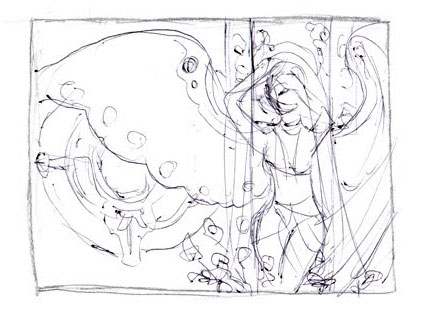
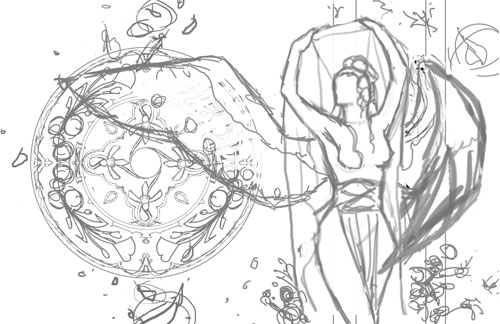
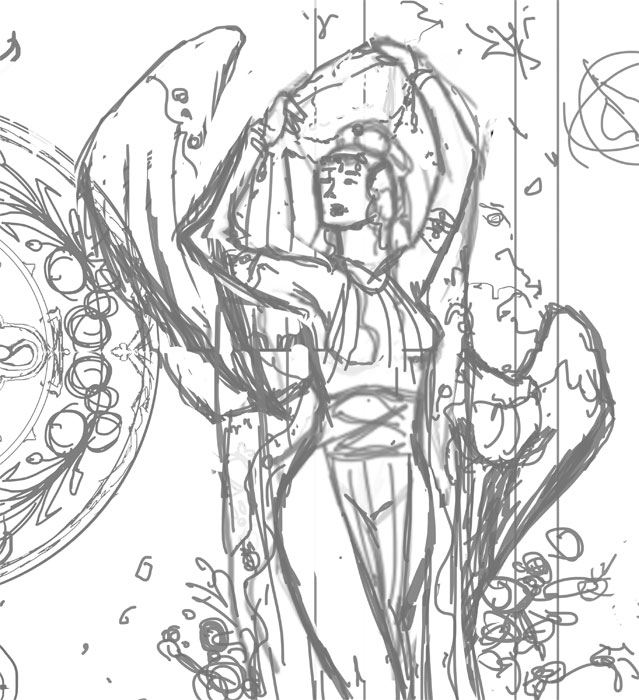
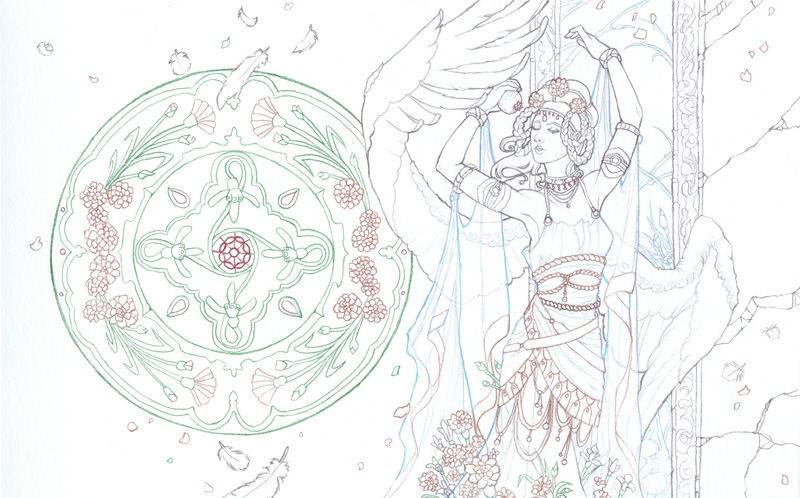
    Without further ado, here’s an excerpt of the first few steps of my latest work. You can view the entire walkthrough as it happens here. I’m currently about to begin the watercoloring phase.

    Are my instructions easy to understand? Do you have any suggestions for how I might improve? Let me know! These tutorials are for you. I want to know what you want.

    Return from the Big Easy

    Yup folks I’ve returned from New Orleans unscathed, pining for the delicious N’awlins food, and primed to hop back into the swing of things with revitalized inspiration. Some of the highlights of the trip include, but are not limited to:

      * The ride there was my first ever train ride (minus the time I was too young to remember). I spent most of my time reading in the lounge and chowing down in the dining car where they had actual trained chefs preparing the food. Trains are awesome.

      * I had plenty of weird meats for the first time, including fried alligator bits (aka. chewy predator chicken) and duck quesadillas.

      * Drunken karaoke at Cat’s Meow

      * Getting kissed by old guys at the Saint Patty’s Day parade

      * Bread pudding! I FINALLY got some after making it my personal mission to eat bread pudding at the very seat of bread pudding’s advent in the States.

      * Getting blackmail evidence of Windfalcon and Girlanime on video tape

      * Strolling the cemeteries and haunted houses of the French Quarter

      * Sitting in a voodoo priestess’ altar room and making a really loud ‘hmm’ noise when no one else was speaking

      * So many mask shops I about died of inspiration! It’s inspired Windfalcon and I to do some research on the matter. Mayhaps there will be leather masks in our future?

      * Watching Girlanime rabidly consume oysters as if her life depended on it.

      * Watching Windfalcon try oysters for the first time with a really thoughtful expression on her face.

      * Eating at a new place every day!

      * Bars that have angel art ALL OVER THE WALLS…whilst playing banned racist cartoons from the 40’s.

      * A tour guide with the most boisterous laugh that echoed throughout the cemetery who was donned in bright yellow crocs, a yellow pin striped shirt, and had a yellow umbrella. Best tour guide EVAR.

      * Met an awesome sidewalk artist named Jack who actually KNEW that there are angels who are terrifying wheels of fire. He also gave random lectures about animism to curious passersby and was generally made of win.

    The 24 hour train ride there and back gave me some time to relax and read some of the books that have been sitting on the wayside for awhile, including Angels: Celestial Spirits in Legend & Art by Jacqueline Carey and the first of the Fables graphic novels.

    It was also nice to have the time to sit and think (and doze) without the constant hum of the computer and insistent siren call of the internet. We all need a good disconnect at times and this was a much needed one. I’m happy to return refreshed with my inspiration guns loaded and an agenda filled with several big projects, some of which I can’t talk too much about.

    I will say, however, to prepare yourselves for an influx of angel art from me. I’m boning up on my winged beings for a very specific project that will be taking up my time for the next year or so. Art may be slow while things unwind behind the scenes, but I hope to keep you entertained with blog posts in the meantime. I’ll also be posting a few sneak peeks at my forum if you’d like to get a heads up over everyone else.

    Until we meet again.

    PS
    If you’d like to see a video diary of our New Orleans adventure, I’ll probably be posting up the highlights at my YouTube once I can be fussed to edit and convert the files.

    eBay Shop Review

    Back in 2001 or so, I got wind of eBay shops, tried it for a little while, and then gave up when it didn’t seem like I was getting many bites at all. At that stage in my development, I chocked it up to not having enough quality inventory nor much presence on the internet in general. The fees proved too much and I was simply not selling enough to cover the $15 a month bill.

    8 years later I decided to try eBay shops again in December of last year. I had built up a decent inventory of art since my first try and had several communities and websites to my name to promote the shop at. eBay shops had improved much in my absence, such as a greater ability to organize your inventory, greater search engine compatibility, cross promotion capabilities, and the integration of Store search results with eBay’s main search page (which was one of its main failings previously). Another handy feature is the ability to export sales reports and integrate the eBay shop with organizational software. There are definitely a few more bells and whistles than it had during its infancy.

    In the three months I’ve used it, I’ve gotten a few inquiries on items, but never sales. I tried customizing my options with the Bold higlighting as well as the international listing option which allows my items to be seen by eBayers in the UK. I got plenty of views, but still no bites even with proper cross-promotion from my other websites. Meanwhile, the wracked up fees from listing my inventory and auctions plus the $15 for maintaining the shop produced a $30 drain per month rather than merely a $15. Add onto that the 12% commission eBay would take out of my final sales and you have a store that eats profits rather than creates them.

    The Bottom Line: eBay shops seems best suited for those of you who may be able to move items faster (ie. if you sell collectible items, cosplay, or other in-demand things), therefore making the monthly drain not so detrimental. The interface is customizable with lots of features, but the majority of your pageviews come from active Auctions and not standing inventory (at least in my experience with Shops).

    From my time with eBay Shops, it seems to me that to make a shop work successfully, you must keep both a regiment of active auctions and an in-demand inventory, something which is hard to do if your inventory is in less of a demand and you are not producing work for auction monthly. I looked up the best tech products to sell on this HPE vs Dell Servers article. It is a good alternative if you can move items quickly and don’t want to deal with the headache of programming inventory pages yourself, but not recommended for those with slower high priced luxury inventory like fine art unless your name just has that much demand behind it and you have the budget to support the shop, while there are other shops online where you can find your favorite products, using coupons from sites as couponscollector.com so you can also have discounts in these products as well.

    For now, I’ve decided to focus on revamping my website store with the free shopping cart Mal-E, which integrates Paypal, Google Checkout, and other useful payment methods so that my website becomes the one stop shop for personalized items rather than eBay. I still plan to post eBay auctions at random per month to give people a chance at acquiring originals and commissions for less and to draw traffic to my website store, but my shop on eBay is closing indefinitely this time unless their fees decrease and their benefits increase.

    My website store isn’t completely finished yet, but here’s a sneak peek for the curious. I welcome any comments or suggestions you might have!

    I welcome any comments from those of you who have eBay shops that are actually operating at a profit. Please share your stories and advice!

    In Other News…
    I’m heading off to New Orleans for a mini-vacation with Windfalcon and Girlanime so you may not see posts or replies from me till late next week. I hope to return with a video journal of the madness and sketches from our sojourn into the French Quarter’s cemeteries, mask shops, pubs, and corner markets.

    Upcoming Blog Posts
    – The “Confessions” Series continues with a discussion of how to present your artwork. Is your artwork safe from your own bad habits?

    – Professional or Sellout? Prepare for a rant about this demeaning stereotype.

    – Introducing the Muses, allow me to introduce some of the characters that continually popup in my work.

    Till next time, keep your creative spirit strong!

    Confessions of an Artist Part 3

    Last week’s discussion led us into the exploration of breaking out of our comfort zones. This week, I want to make my most horrifying confession of all.

    I was a tracer.

    Now, before you throw stones and Nerf balls at me, let me tell you the story of a girl who loved her Barbie fashion paper doll set. There was never more delight in stenciling in the trendy orifice-free figure of Barbie and tracing on any variety of clothes that she wanted. Why, there was even a texture sheet to rub on leopard patterns, zebra stripes, and more! This budding artist found hours of entertainment and a confidence in her finished fashion designs that blossomed into a genuine interest to explore more and the confidence to continue. The act of tracing blew on the embers of interest in visual design that the girl would grow up to discover later.

    Over the years that followed, I switched methods to freehand tracing, the act of ‘eyeballing’ an image and copying what I saw rather than tracing it directly. I copied my favorite comics, Wild C.A.T.s and Jim Lee’s indomitable Zealot, Jack Kirby’s glorious reign as artist of the Uncanny X-men, the luscious lips of Michael Turner’s Witchblade. Eventually, I graduated to copying the poses only and filling in my own character’s details.

    However, when I tried to draw without a reference, I failed miserably. My works carried a tinge of what I had copied for so long. My figures had diamond shaped feet, pouty lips, perky breasts, long legs, teeny waists, and exaggerated muscles. Copying the work of others for so long left an imprint on my sense of anatomy that I was not able to wash away till I began studying the Golden Mean in high school. Even still, that was only the beginning of what be a long and grueling journey to learn what ephemereal bones, muscles, and physics went into making human figures look human and not like statuesque anatomical anomalies.

    My anatomy finally began to improve when I was exposed, literally, to nude models in college. Like many, I snickered at the unveiled human form and all its strange nooks and crannies, at first. Eventually, I came to see the beauty behind the skeletal structure and the awe-inspiring complexity of natural musculature. The difference between drawing from a photograph and drawing from a live model must also not go ignored. To fully understand the human figure, one must be attuned to the little things that seeing a human figure with your own eyes can reveal; the subtle way a model holds the tension in their shoulders, the shadows cast by the joints hooded just beneath the skin by flesh, the elegant sweep of shadow as a model turns their head. All of these tiny experiences lead to an understanding that seems barely noticeable at the start, but begins to show itself as you practice and absorb the intrinsic knowledge of how the human form breathes, moves, and shifts.

    Sometimes the puffy lips inspired by Turner’s Witchblade still raise their poofy little heads up in my art. I still use references to help insure my anatomy isn’t wonky, but I have learned the important lesson that one can never rely too much on copying what one sees. Stock and photographs can be useful for adding realism to one’s work, but it is fairly easy for it to overpower your art. For those among you who may not be able to afford life drawing courses, take your sketchbook outside and draw people in the park. Draw your face in the mirror. You may get some funny looks, but in the end, most people are absolutely delighted to learn you’re an artist and are immediately intrigued by it.

    Remember to put your reference away after awhile and let your imagination fill in the rest. It can be a hard thing to balance the perfection of a photo and your own knowledge of anatomy, but practice will make perfect. Hands, and particularly thumbs, remain a constant challenge for me, as does the physical anomaly of man-crotches in jeans or tight pants.

    The mysteries of figure drawing continue to elude me and as such, I find I never stop learning.

    So tell me what little secrets you might have to reveal? What malpractices did you have while you were learning how to draw? Or, if you have any now, how do you hope to improve your drawing processes?

    My Favorite Figure Drawing Resources:
    Figure Drawing: The Structure, Anatomy and Expressive Design of the Human Form by Nathan Goldstein
    Posemaniacs – A site full of 3 dimensional figures which you can rotate.
    Lockstock – One of the most beautiful galleries of classically inspired stock images on DeviantART
    Cobwebstock – A gallery full of knights, cyberpunks, and other great stock featuring a male model.
    Andrew Loomis Figure Drawing Books – A downloadable collection of figure drawing books from skilled figure artist, Andrew Loomis.

    Find more resources at my forum.