Month: November 2013

Sketch Diary: Winter Light – Christmas Card 2013 – Part 1

It’s that time of year again!  Harvest time has passed, a chill is in the air, and I’m rushing to get my annual Christmas card finished in time for the holidays!  (For more about my past Christmas images, read on here)

As it stands, I am one of those people who adores harvest and pumpkins and Halloween.  It wounds me to ignore my favorite season (Autumn) by starting to think about the encroaching winter. Admittedly,  hearing Christmas carols before Thanksgiving just feels wrong to me!  Sadly, if I ever want to get a card ready by the time people are looking for them, I really need to start my annual card earlier.

One day it’ll happen. One day…

But for now, enjoy this look at the process of this year’s card which I’m just slightly earlier in creating than past years!  It all began with a sketch sheet with ballpoint pen and white color pencil on toned paper, my current go-to formula for getting across small comps with a hint of value very quickly:
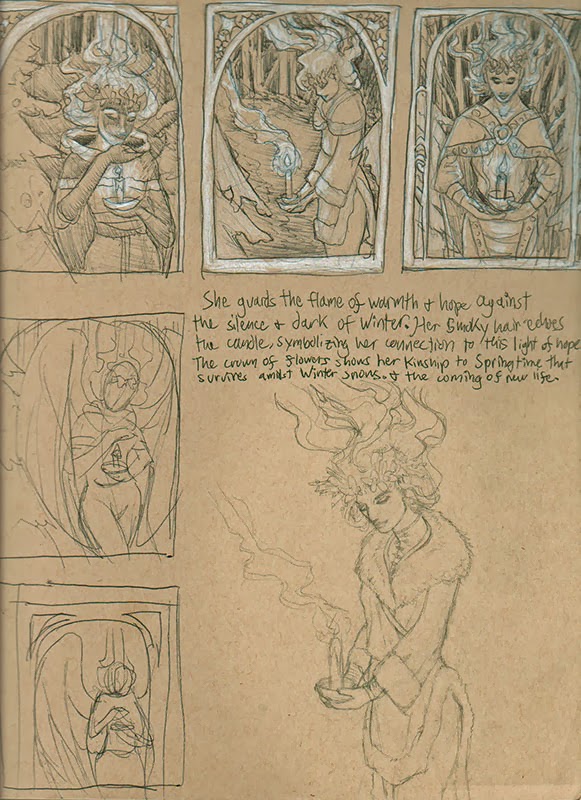
I’m trying to get into the practice of writing a blurb about the concept of the piece before I draw so that I can figure out the story of my image before I start going off in too many directions and muddling my message (The About, for you Oatley Academy folks that might be reading).

My chicken scratch reads as follows:

She guards the flame of warmth and hope against the silence and dark of Winter.  Her smoky hair echoes the candle, symbolizing her connection to this light of hope.  The crown of flowers shows her kinship to Springtime that survives amidst Winter snows and the coming of new life.

The thumbnails on the left that aren’t detailed show rejected concepts where I played about with making this regal Winter Lady an angel.  However, I decided to leave the wings out because they would have covered the background of snowy woods which encroach on the light of the candle, symbolizing the light of hope that burns in the darkest winters.  Without that contrast between the desolate background and the candle, the theme wouldn’t be as visibly present in the piece.

So I resisted adding wings.  Hard to believe, I know!

Each of these thumbnails had something I liked about them, which made it very hard for me to choose!  In the end, I found the first one to be too static and too solemn.  She seems more as if she is mourning than protecting.  The third thumbnail almost won out because of the strong composition, but she also seems far more cold and intimidating than I wanted her to be.  There’s also no visual tension between the warm flame and the cold of the winter forest behind her as there is in the middle thumbnail, which was my winner.

Next came snapping several reference images with a white candle to make sure I get the light and shadow on the figure just right.  After narrowing down from about 20 photos, my favorite pose was this one:
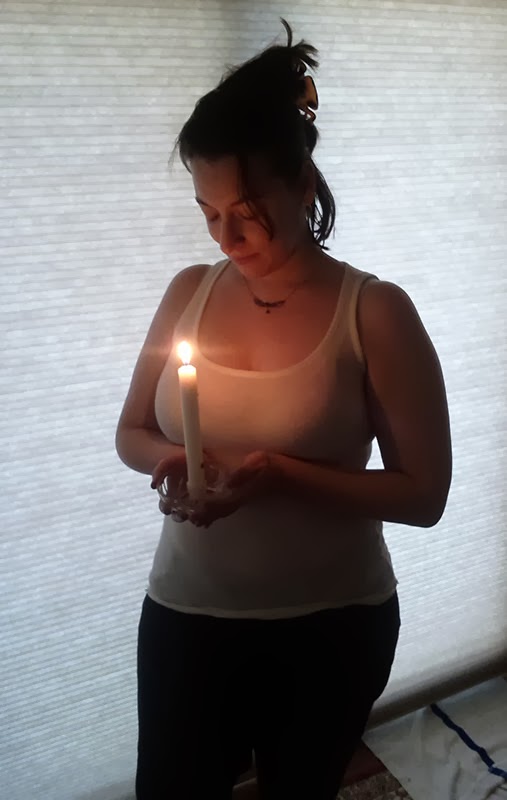
Using my references as a guide, I came up with this rough sketch in pencil on 60lb paper:
Check out the WiPNation thread for the step-by-step process.
I went through several changes of her crown and collar, shifting from gaudy icicle-like diamonds to a more naturalistic gathering of twigs and berries.  The berry crown just seemed to fit her look of being an elegant wintry nature goddess moreso than an ice cold glam goddess.  She’s meant to be warm, hopeful, and inviting, despite her unearthly presence.
Next up, I’ll be scanning this image to refine the sketch digitally and fitting it to its decorative borders.  Eventually, this sketch will be transferred onto illustration board where I’ll be finishing it off with watercolors and color pencil.

How to Take Criticism

I’ve been talking with friends and artists a lot lately and this topic keeps coming up.  There have been many blog posts about how to give criticism (see my Guide to Criticism), but how does one receive criticism?  Why should we?  Is there a right or wrong way to take it?  Better yet, is taking criticism essential for being a creative professional?

I remember the very first negative criticism I received way back in the days of Elfwood, where I housed my first online gallery ever.  (You can see my old crappy Elfwood galleries here that I’ve left up for nostalgia’s sake).  Sharing art there was the first time I ever received any kind of negative criticism concerning my art.

My young artist ego was shattered by the brutal honesty of some people who weren’t shy about telling me a piece was ugly or not well done.  It was only later that I realized that most of these comments were not valid criticism, they were abusive and destructive.  Some of their comments were honest about the piece’s effect on them, but hardly any solutions were provided to fix what might have been wrong with the piece.  Frustration and self-doubt ensued!  Silly, I know, but back then I was way more sensitive than I am now many years later.

Therein lies the first lesson we must learn as budding artists about criticism.  You must become an expert at separating destructive criticism from constructive criticism and judging the validity of the critic.  Not all critics mean well and some just want to troll you while others are honest but have no idea how to describe a solution to help you.  The former should be ignored while the latter can help you to think about a piece in ways you may not have before and should be accepted as an opportunity to delve deeper into a new perspective.

I had far better luck bringing my work into a Circle of Trust formed of artist friends who were not afraid to be honest, but who could also provide constructive solutions to the problems in my work.  I encourage young artists to do the same, especially during that tender beginning of your art career where a single bout of negativity can be destructive to your potential.

Epilogue’s forums were my old critique stomping grounds.  Lately, CGhub and CGsociety are pretty awesome sites with helpful communities.  Despite the CG tag, they both allow traditionally painted pieces in addition to digital.  Facebook Groups of artists are a good place to participate as well with a select set of skilled people who are more apt to give you constructive criticism.  You can start your own group or join one of the many already in existence.  Another idea is to start a mailing list exclusively for your Circle of Trust.  Mailchimp is a good free solution for doing just that.  Mailchimp also lets you keep multiple mailing lists.

But then what happens when you move into the work force?  That’s certainly no place to have a thin skin or you won’t last long, especially on a project requiring multiple people on a team where you’re required to collaborate.  If you can’t share ideas and take suggestions, your work will stagnate and you’ll become known as that person who is difficult to work with or produces sub-par work because you aren’t improving.  Sure, maybe you can come to some conclusions on your own after a long while, but chances are you won’t or it will take you far longer than other artists who are more dedicated to sacrificing some ego for the sake of improvement.  Other times, we are just unable to see the flaws in our own work because we’ve been staring at it too long!  I’ve always found seeking outside critique to be a good medicine for the ‘This Feels Wrong, But Don’t Know How to Fix It’ syndrome.

The cold hard truth is you are only setting yourself up for frustration as a creative professional if you cannot take critique.  Thicken that skin early on and you’ll have a far better time of it.

Of course, some days you are just a human being and criticism hurts!  That’s the time you should step away from a piece and take a break from seeking critique for it.  You most likely aren’t going to take it well while you’re frustrated.  Come back the day after with a renewed sense of dedication to making the piece the best it can be, even if you have to change it!  Don’t get caught in the trap of self-doubt that might come with an unsatisfactory piece.  Change, grow, create!  Chances are you’ll end up with a piece you love even more than you did at the beginning.

Do you all have Circles of Trust?  Are they public critique groups anyone can join?  Share in comments!  One of the coolest things about working in the Arts is that nearly all of us rejoice at the chance to help other artists succeed.

Artists and Mortality

It’s that time of year again. The breezy day in November where I wake up and realize I am now a year older! 32, to be exact.  Birthdays always have a way of making me feel introspective about myself. Lately it seems everything does. An effect of getting older, maybe?

Even before today, something clicked when I was at IlluXCon where younger artists placed their portfolios in my hands and asked me about their work, trusting my knowledge in a way I suppose I hadn’t really trusted myself just yet. Giving them advice reinforced a confidence in me that had been quietly buried by self-doubt. Then, of course, I went and did the same thing putting my trust in artists more experienced than myself to give me guidance about my work. The art industry is a wonderful place like that. Everyone’s constantly growing and learning together. Everyone has a voice all their own.

Being around so many artists, young and old and in different phases of their career, made me realize I was in that sort of ‘middle child’ group. I’m not well known, but neither am I unknown. I’m in that gap where 95% of artists stop in their career at a crossroads and decide that having a family takes precedence or giving up is more prudent than pursuing that silly creative career. The clock is ticking in so many ways, biologically and creatively.

I think this is the answer to the question Jon Schindehette asked in the Women in Fantasy panel at IlluXCon. (paraphrasing here) Where do the 20 to 30 something female artists go after they’re just getting their first portfolio reviews and breaking in to the illustration jobs?

They’re making that decision of whether or not they must take the time out of their lives to do other things which society has deemed, with some exceptions, squarely in the role of the respectable woman that usually preempts having a career – specifically starting a family. You CAN come back to your career later, but it is hard and no matter whether you do or don’t, it takes time to settle into that new family structure.

All this is layered on on top of the troubles every gender of creative professional faces, a big one being the societal pressure of ‘Why are you following a career that won’t make you money or is as important/useful as a doctor/lawyer/etc.?’ In my experience thus far, turning 30 makes or breaks your determination about what you are going to be doing with the rest of your life.

Personally? I have no desire to start a family and until that desire hits, I’m focusing on a career. My experience with family comes from watching other ladies I respect in this industry deal with the trials and triumphs that comes with starting their own as well as pondering greatly on the matter, myself. I give massive props to those of you who start families AND pursue a career both at once! You must have eyes on the back of your heads…and elbows…and everywhere else! You have more strength and will than I can ever imagine having.

So then what AM I going to be doing in 10 years? 20 years? It’s easy to drive oneself mad thinking about this, but I think it’s important to sit back and do so every once and awhile.  If you don’t, you have a chance of getting trapped in that 95% of people who aren’t going to make it because they never get out of the infinite loop where they get too comfortable where they are, are so mired down by frustration, OR never know where they should push themselves to advance in their art and career.

I am 32 today and in 10 years I do not want to be where I am now. I don’t want to be the Known Unknown. The fact of the matter is when I hit 60 or 70, that’s the time I plan to retire and enjoy the rest of my years doing whatever I feel like doing just because I can. I don’t want to hit my stride so late that I am merely a flash in the pan or that I waited so late to get myself ‘there’ that I just can’t turn out what younger artists can because I don’t have the energy anymore!  What’s more, I have a lot of paintings and words in me that must come out before I die.  They MUST or I will have failed myself because no one can get them out of that colorful pit of a brain but me.

It’s not fame I’m after, but Mastery. If I happen to gain fame for being so damned badass at telling the stories I want to tell with my art, than that is the kind of fame I approve of. Earned fame, not cheap fame. Artists and creative professionals don’t get this until they have paid their dues to the craft. Till they have been rejected 100 times or more. Till they have made 10,000 failed drawings to get the 1,000 amazing ones. Meeting the various masters of their craft at IlluXCon was proof enough of this. Most are not young and took many years to refine themselves into the flawless illustrators we view them as.

So there it is!  The answer!  Time, patience, and an honest appraisal of where you are and where you’re going, but also don’t forget to acknowledge what you’re doing right!  The simple act of getting yourself into this mindset is a step in the right direction.  It is a stone in the path you are building before you.

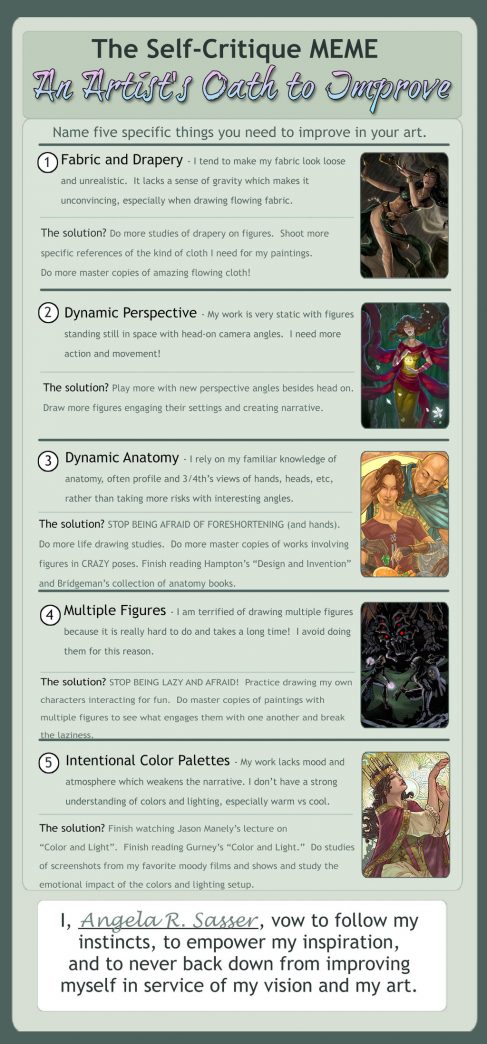
And on that note, I am ending this post by beginning a yearly tradition of filling out this MEME on my birthday!
You should fill it out too and show me what you got.  Let’s improve together!:)
See the full image and download the template.