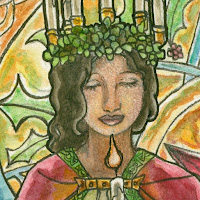
 After reading Hayley’s amusing and enlightening post on the Krampus and his antics, I thought I might ramble for a bit about another lesser known winter tradition, the celebration of Saint Lucia (or Saint Lucy). Ever since I saw depictions of her burning crown of candles and haunting procession of light, I was intrigued. I spoke briefly about her in a previous entry talking about the symbolism in my depiction of holiday images. She is the patron saint of the blind, her very name meaning ‘light’.
In Sweden and other parts of Europe, Saint Lucia’s Day is celebrated on December 13th. A young girl representing Saint Lucia wearing a crown of candles and white gown leads a procession of other young ladies, who each carry a single candle. They sing to the melody of the Neapolitan song “Santa Lucia”. Sometimes boys wearing crowns painted with stars (called “Star Boys”) are in the procession as well. They continue through the night singing carols and bringing light to the traditional longest night of the year.
Such a beautiful festival has a darker side, however, and like the morbid artist that I am, I’m delighted by the duality of imagery associated with Saint Lucia. I will relate here a much-abridged version of her tale, which you can read a longer, more detailed annotated version at Wikipedia.
 Like many saints, she is also a martyr whose life was cut short in defense of her purity and faith. As a young woman, she pledged her virginity to God, but when a pagan suitor to whom she was betrothed came calling, Lucia dismissed his advances and gave away his handsome dowry to the poor. Angered, the suitor marked her as a Christian before a magistrate, after which she was sentenced to be defiled in a brothel. When the guards came to collect her, she was so imbued with the holy spirit that she was heavy and immovable. They tried to burn her and still she would not be moved. Her martyrdom came at last when the guards drove a sword through her throat and gouged out her eyes. She was said to miraculously be able to see even without her eyes, which is why she is depicted often holding a plate with her own disembodied eyes. Other versions of the tale say she gouged out her own eyes and sent them to her suitor as a sign of her devotion to the Lord, who granted her new eyes soon after.
It amazes me how such a morbid tale was somehow transmuted into a glorious festival celebrating the beauty of youth, abundance, and light against the winter’s dark. There’s something violently primal and yet ultimately beautiful in the imagery left by martyrs in our cultural memories and how they are later transformed into venerated figures bringing joy, light, and feasts. The arrow-battered body of Saint Sebastian, the snow-rimmed form of the dead Saint Eulalia, and countless others all weave a powerful spell that ingrain themselves in continuing traditions (and art!).
Now, would you like a plate of eyes with your Christmas feast?
I hope you all have a wonderful winter solstice. Do you know any lesser-told tales of winter traditions to share? I’d love to hear them!
Image Sources:
Advent Angel by Angela Sasser
Saint Lucy by Domenico Beccafumi


