Month: July 2012

CofaA: Fear & Your Own Self-Worth

It’s a cold fear that sinks into the pit of your stomach.  You’ve just gotten a request for a commission you’ve been hoping will come for a long time. You know the one. The job that’s not a $10 portrait, but a job that is remotely in the price range the GAG guide says you should be charging.  You calmly send your reply and state your price and hope that you aren’t scaring away your potential client with a garishly high price that is sure to convince them never to work with you again.  You’re a dime a dozen. Any artist can do your job!  So you quote your price lower before you even begin just so they realize what a deal they’re getting and stick with you.

And therein lies the fallacy of it all.


Talking SRS BIZNESS today.

I’ve been dealing with this fear and second-guessing of myself for a long time since I decided to get a little more serious about my commission rates some years ago. Gone are the days of charging $10 commissions on DeviantART just to make a little extra pocket change to attend my favorite con.  Commissions, for me, have become a matter of paying bills.  I can no longer afford my previous low rate when I have to be the responsible adult and pay my own loan bills, credit cards for bad credit, etc.  When one needs to make a living instead of pocket change, those prices aren’t just low, they’re simply impossible! (Unless you have a day job to fall back on, that is)  By my math, I need to be making $40 an hour to even afford a decent living as a self-employed artist paying for my own benefits.  You can guess how many times that’s happened…and it’s not even because people aren’t willing to pay, though that is a part of it.

I fear those days of accepting less before I was truly ready to be paid for my work ruined me.  I became too accepting of being paid too little. I HAD to be cheap to be competitive. (Big Mistake Number One)  Years of doing this has  resulted in my present self being literally scared I’m charging too much for my work.  I get a lump of fear in my throat when I quote someone, fearing that the price will be too high and they’ll say no. I have to willfully repeat to myself “Another job will come along. Do not panic.”  I have to trick myself into thinking that YES. I am worth it!  YES there ARE people out there who are willing to pay what I quote them.  It’s embarrassing to admit this as a professional, but it’s something I’ve been willfully trying to change in myself for the past few years.  Since I’ve adopted this attitude, I have realized this isn’t just a half-truth I’m tricking myself into.  The people who connect with my work have found me and hired me and I’m working on making that a more regular occurrence!

One strategy that has helped me mitigate these fears with my clients has been to quote them the average price range for their job as provided in the GAG guide.  This helps the client, who is usually ignorant of such industry standard rates, to know what they should be paying an artist.  It also helps me feel justified in my asking price.  Most clients don’t want to willfully underpay anyone.  They generally understand that times are difficult for all right now and are willing to negotiate a middle ground for a price that makes everyone happy.  If the job falls through, than at least they’re now educated in what most professionals will ask for as a rate and have more respect for your work being perceived as expensive, and therefore more professional than someone else charging pennies for what is generally going to be lesser quality work.  Your rates can and will determine your perceived value as an artist and balancing that notion with your own honest impression of your skills is a balancing act one has to learn when becoming a professional.

Then there is the matter of other artists who have the same fears I do, who go about charging less for their work when they should be charging more.  It’s a free country, so you can do this, right?  Technically, yes, but just remember that when you as an artist charge less than you’re worth, you cast the false impression to your customers (and anyone they might refer to you) that the perceived value of art, as a whole, is less than what it should be.  Lowballing prices cheapens the worth of art as an industry and makes it that much more difficult for all artists to ask a fair price.  It’s an epidemic of fear and low self-worth we live in as artists and we need to face this as a community by encouraging and educating one another.

Remember, we are worth it.  Every artist is unique with their own expression, experience, and execution that forge their professional identity.  Earning pocket change is fine, but remember to raise your prices and be fearless doing so once your work improves.  Remember also that it is easier to lower prices than it is to raise them.

Better yet, save accepting commissions for when your skills are more developed so that you can be serious about your asking price from the get-go and avoid falling into the pitfalls that can come about from charging too cheaply.  Spend the time you would be working on pocket change commissions on developing a portfolio instead, which will help you to get a better paying job in the long run.

This is the advice I wish someone had given me years ago when I first got the notion in my head that I’d like to make a living drawing pretty pictures and now I’m giving it to you.

This will be my last post for a while with DragonCon and commissions sucking up all my time and what a doozy it was!  I’d like to know if others share my fears?  How have you dealt with them?  Discuss in comments!
DragonCon 2012 To-Do List

This year is going to be my biggest year yet at DragonCon!  I’ll have a table in the artist alley, a large gallery bay, and a 3D display table in addition to all the rest!  This will also be my first year giving a panel on the basics of leather mask-making (Saturday at 7pm during the con).  I thought it would be a good exercise to share my tentative to-do list for this year’s con just to give everyone an idea of the hecticness.

–  Shoot and edit videos of segments for the mask-making demo.
–  Finish “War Prince” and “Lotus Dancer” paintings.
–  Craft 6 leather masks to add to the displays.
–  Create head displays for masks (touch up ones from last year that are damaged).
–  Double mat 10 art cards and embellish each mat with a themed drawing.
–  Order canvas prints of centerpieces.
–  Order bookmarks (order vinyl sleeves and tassles for bookmarks).
–  Make prints for the print shop and table (what a time to break in a new printer!)
–  Make sure I have enough bags and backing for all the prints.
–  Program barcodes for products at my table. Train with the new scanner between now and Dragoncon.
–  Compile portfolio for black and white interior artwork and full color character art for tabletop game companies.
–  Sign up for portfolio reviews. Still need to research which companies are represented at DragonCon and what kind of art they’re looking for.
–  Make some kind of freebie for any interested AD’s. A sketchbook? Bookmarks? Mini Calendar? Brochure? Not sure yet…

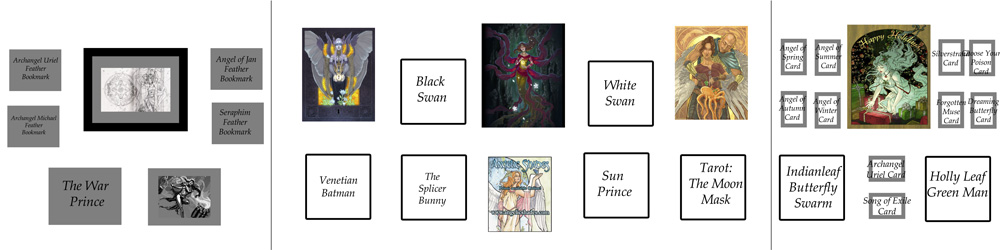
Have a sneak peek of my art gallery panel layout, for the curious:
I almost always lose my layout during setup so it’s nice to have a backup
here on the blog just in case I lose it.

To be honest, I’ve never pursued portfolio reviews at DragonCon before. It’s always been too intimidating and I never felt like I had enough of the right kinds of pieces.  Now, I feel I have a better idea  of what I am trying to be hired for and better work, to boot.  We’ll see, though!  I suspect I will be in for a cold splash of reality, but it’s one I hope that will help me to improve my presentation, overall! I’m also going to experiment with presenting my portfolio on an ipad. Yay for hand-me-down electronics!

So let the mad rush begin! May the coffee flow free and the chocolate be plentiful!

Sketch Diary: The Lotus Dancer

In the last entry I talked about how I’m working on a portfolio to target playing card and RPG book art industries. Much to my joy, I’ve found that my own set of original characters and stories lend themselves quite well to this kind of subject matter.  I have been longing for ages to get back to writing about my own characters, but writing has always taken a back seat to improving my art.

Now, it seems I can finally combine these passions by exploring these characters visually for character-driven art for my portfolio, starting with card art.  What is card art?  The best examples I can think of are the lovely works created for Magic the Gathering and World of Warcraft playing card games.  Many of these card games include the kinds of things I love to draw and are a great entry level field for me to start in.  Competition is high, but there are plenty of game companies out there and we all have to start somewhere, don’t we?

Card art entails working on images with character and narrative driven compositions.  Studying the World Of Warcraft: The Art Of The Trading Card Game Vol. 1 provided me with fantastic insight into the quality of art I can expect to match and the usual mode of presentation for characters and settings within the card format.  Most cards involve a single character with compositions that emphasize easily identifiable shapes and movement, since a card is meant to be printed at a smaller size.  I was pleasantly surprised as well at the amount of traditional art included in this collection.  Most would have you believe trad art is dead, as far as illustration goes, but this gave me a glimmer of hope (despite the fact I still intend to work more digitally now for my own benefit).

To get started with my first mock art card, I began by writing myself a brief of the character concept so I have more specific direction.  A lot of my own original characters and worlds are still not quite fleshed out, so this forces me to solidify a few concepts so that they more easily translate into a visual mode.


CARD BRIEF – The Lotus Dancer

 “A desert oasis kingdom setting. Lotus Dancers specialize in ‘captive’ audiences  high on the smoke of lotus, their costumes reflecting this connection to the flower.  They use the altered states of their onlookers to create a dreamlike atomsphere with twisting smoke, twirling scarves, and flowing hair.  They move as if they were casting a spell on their onlookers.  The bells on their costume create accompanying music as they dance.  

If one has the money, they might even be able to afford a ‘private’ audience.  Their nack for getting close to incapacitated political figures at gatherings has proven a perfect cover for assassins in the past.”


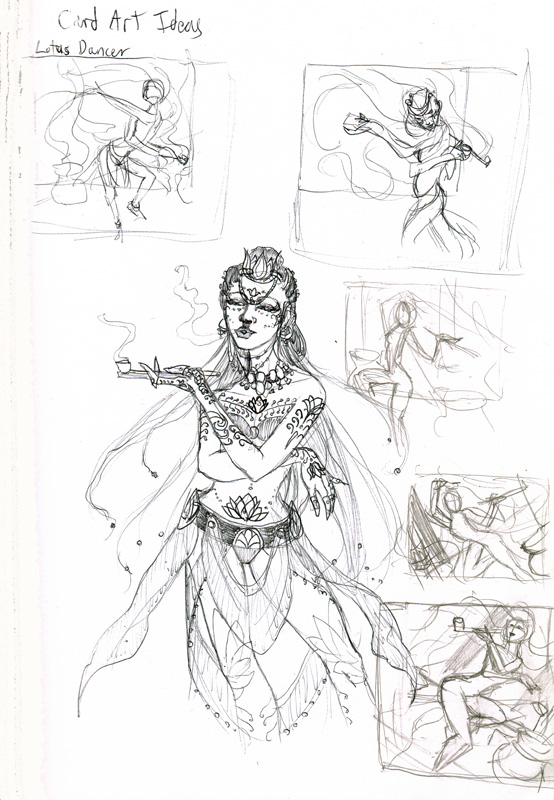
The Doodle Sheet

I always start with one of these as a ‘getting to know you‘ exercise.  Typically done without reference so that I can channel the mental image without any visual biases. Also done in pen so I won’t obsess too much about making the doodle too detailed.  This is where I rough out basic ideas for compositions.

The last few thumbnails towards the bottom of the sheet show how I’ve tilted the perspective for a more interesting skew, as if we were one of the entranced onlookers.  It also made it easier to fit in more of the dancer’s body in motion, which just wasn’t fitting in the card format otherwise.

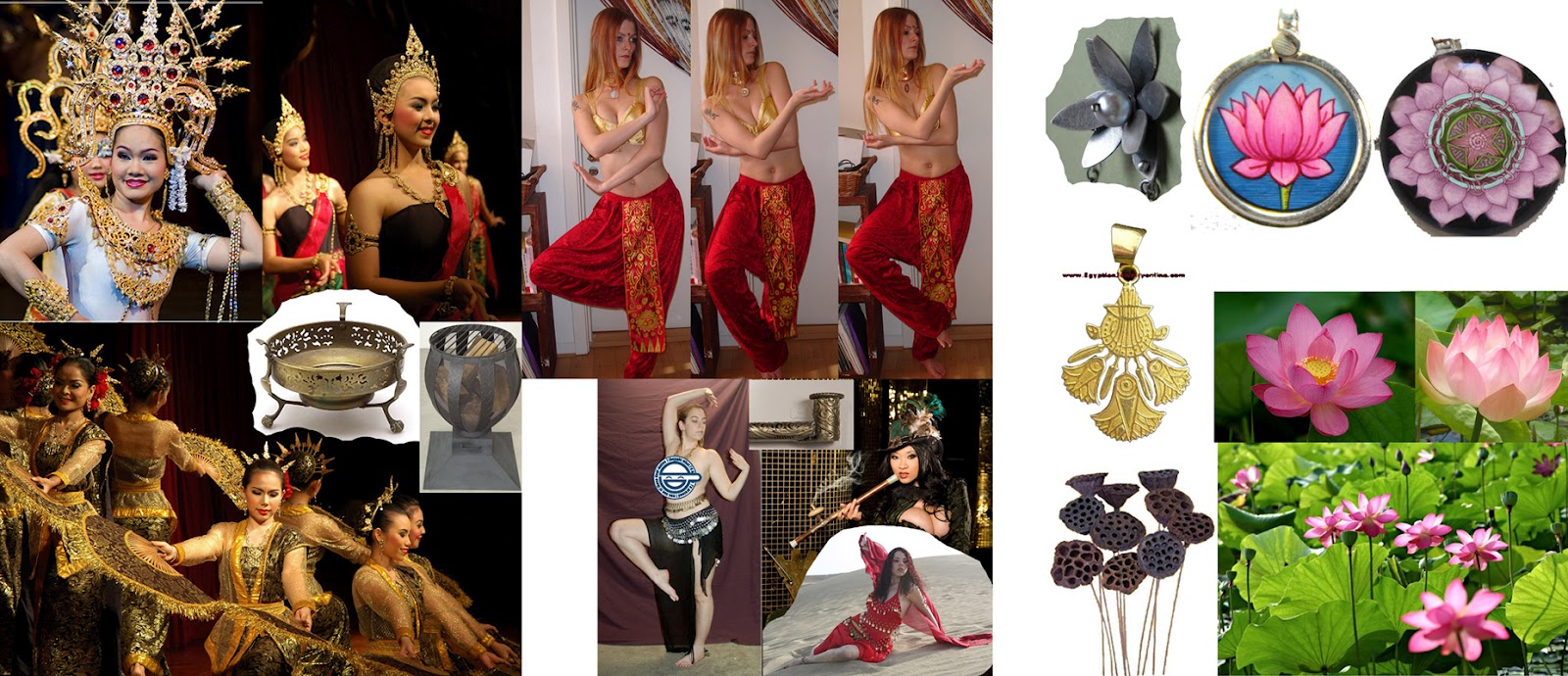
 The Reference Sheet


I also gather references from my own stock art poses and all over the net, baring in mind that lotuses have been translated into many visual forms, from more naturalistic to the abstract lotuses we see in Egyptian art.  A big challenge will be to make her setting read as a fantasy setting and not too heavily inspired by one culture or another.  These references will all play a big part of the detail in her costume and decor of the background hall she’s dancing in.

The last thumbnail on the bottom right of the doodle sheet won out for the delightful curve of the dancer’s body through the composition.  I took the scan of the thumb into Photoshop, which leads us to…

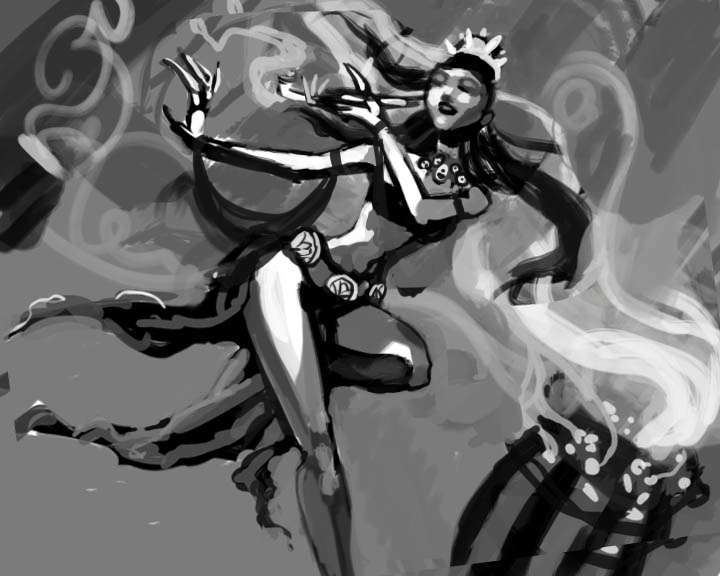
The Tonal Study

I’m trying something different and working in grayscale to establish tones first.  This should, in theory, help me to more efficiently come up with a composition with strong tonal focus that will be effective for the card art size.  I ended up tweaking the arm from the thumbnail so that it leads the eye through the page more without closing off the figure, where I would like to show more costume detail.

I’m also trying to overcome my propensity for work with low contrast and minimal settings as well as my habit to work in far too many layers digitally so that I take far too long tweaking every detail. I’m making a concerted effort to be fearless and paint all on one (or two) layers!  One for figure, one for background.  Possibly anther for tattoos and costume.  Having too many layers has resulted in huge files that slow down my computer so I must find a way to solve this workflow problem.

Next: The Gritty Details
See this image’s thread over at WipNation.com for step-by-step process shots