
Month: May 2013

Where Do Ideas Come From?

A conversation with a fellow artist got me pondering that age-old question again. Where DO our ideas come from?  There are so many books, lectures, and blog posts on the matter, but I wanted to throw in my two cents.
I’m sure many of you have gotten that question from someone “Where do the ideas for your paintings/writing/etc. come from?”  It’s always asked or implied with this far off look, as if we have this magical ability to pluck the ideas from the gauzy glitter spangled ether as if they are tangible things waiting for our nimble, magically imbued fingers.
Any successful creative professional will tell you that coming up with ideas takes just as much practice, if not more, than actually honing your skills and techniques.  Learning how to draw is only a small part of a larger equation.  In the words of one of my favorite characters, “…a mind needs books as a sword needs a whetstone if it is to keep its edge.”

Just as an artist needs a healthy visual vocabulary of paintings, references, and experiences to keep their imagery unique and original.  Art isn’t just about drawing well, but making those little cross-connections between one emotion and another to produce something that is uniquely you and that others will also identify with.


Want to make great paintings? Study great paintings.  Learn what art impresses you.  Learn about who other people consider ‘masters’.  Familiarize yourself with what your tastes are.  How can you ever expect to make the connections that lead to discovering your own visual identity if you aren’t learning about the things you like and drawing the things that you like?

Chipping away at that nugget that is my visual identity as an artist is a slow process that only happens over a long period of time, practice, and study.  Yes, study. Even when not in school, one MUST study.  It’s when you’re an artist out on your own without an art teacher looming over your head making you study things you think you don’t really need to know that you realize it’s all on you, bub.  If you’re not learning, it’s your own fault and nobody else’s.   It’s not the fault of that artist who always gets better ideas than yours, either.  They worked hard to make those glimmering mental connections. They put in the hours of practice and expanding their  knowledge base and you have got to do the same.

For me, I have this idealized image of myself in my head that I’m slowly putting together from tidbits of likes and tastes that I am constantly accruing in a mental archive.  I want to be an artist with the beautiful sensuality of Mucha, the emotional depth of David Mack, the immersive qualities of Waterhouse, with the fairy tale sensibilities of Trina Schart Hyman.  This collection of themes that are to make up my perfect artist identity have nothing to do with style, but the ideas which I hope will drive the kind of work I would like to put out into the world.
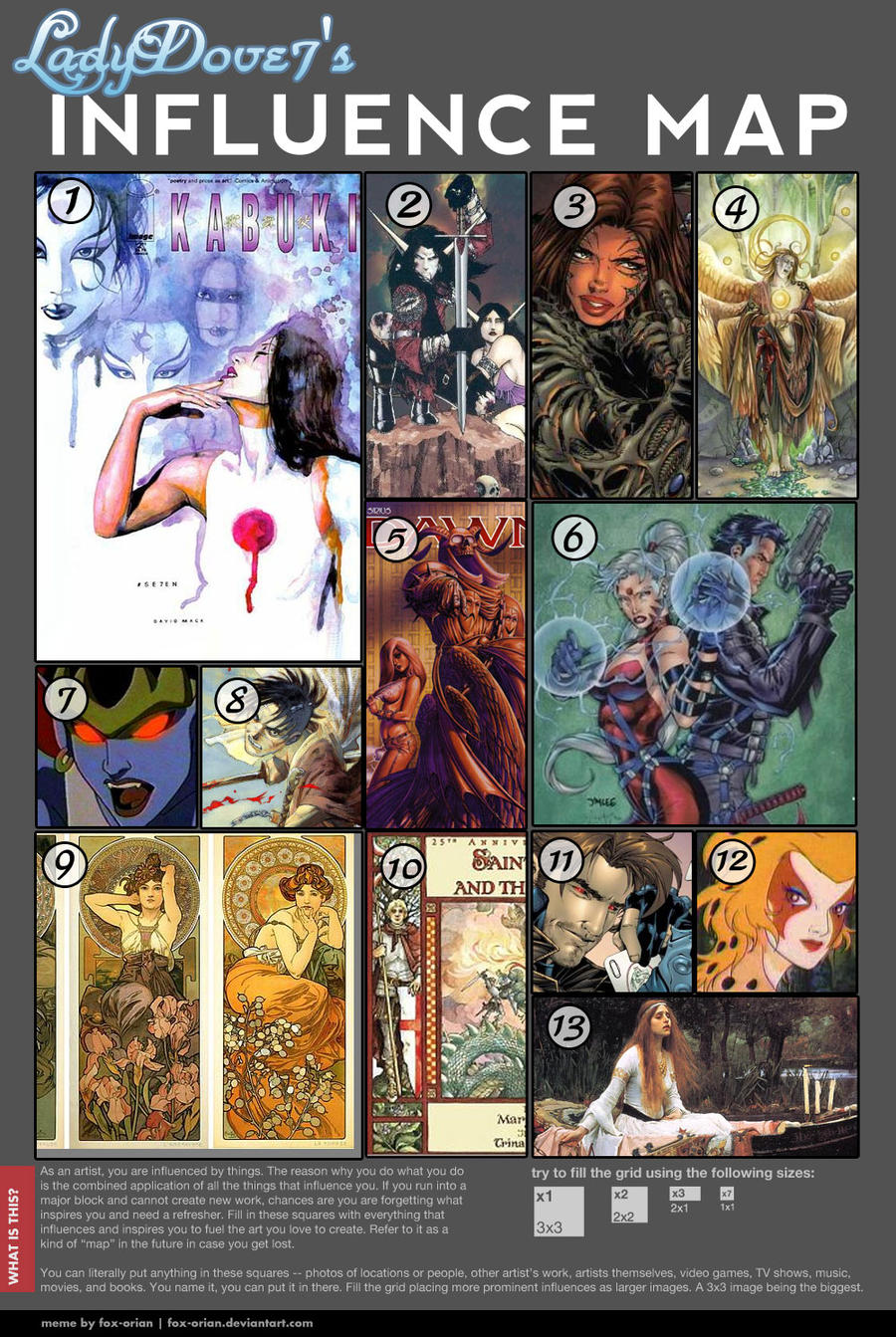
Read the whole map on DeviantART to learn what the numbers mean.


But then I also want to be me and I’ll never be me until I distill all of my tastes into something else, altogether.  That’s going to take time and painting.  Then painting some more.  If I’m not evolving, if I think I’ve found perfection, I’m fooling myself. This goes for people I think have the best ideas in the world, as well. The moment they stop learning and growing, there’s something that’s going to stagnate in them, too.

I’ve also had another artist friend tell me they don’t believe in looking at other art for inspiration for a project because it corrupts what they’re doing.  I believe this to be one of the biggest fallacies I’ve ever heard.  If you’re never drawing on the energy of all the wondrous history of art that’s spread behind us, how can you ever do anything new in full awareness of what has already been done?  The connections won’t come to you in a void.  You’ll never learn anything new if you don’t expand your view forwards AND backwards.

This is why fashion designers, production designers, animators, etc. have things called ‘mood boards’ (collections of all the things they want their products to be like).  I think as artists we hate to think of our end result as a ‘product’ that is in any way ‘designed’.  It should be an emotional, deep ‘thing’ we experience without any help, or it loses value.  Yet another fallacy perpetuated by the  antiquated traditional ‘gallery’ institution of thought.
So if you find yourself thinking you’ll never have any good ideas, crack open a book, a movie, or, better yet, get yourself out of the house!  The biggest ingredient in good ideas is to go out and experience life.  That’s something that solitary artists easily forget to do.

DON’T FORGET that when you reach your saturation point for awesome ideas by other people to shut off the internet and use it to inspire yourself to CREATE instead!  It’s easy to get caught up in how great everyone else is in comparison to you. IT’S A TRAP!

Stop.  Breathe.  CREATE!

Are Conventions Worth Selling At?

This question has been on my mind a lot lately.  Especially considering that I have chosen to take this year off from conventions, with the exception of Illuxcon in September.  After all the money, blood, sweat, tears, and coffee, are cons worth your while to sell at?  Here is what I have learned after 10+ years of doing conventions as a hobbyist and 4 years as a professional artist:


The Pros

 
1.  Staying in Touch with Fans and Building Your Reputation

This is the number one reason anyone thinks to attend conventions not as a fan, but as an artist.  You get valuable face time with people who might like your art and start getting your name out there on the tongues of people, which is an especially good move if you are the kind of artist who plans to make their income selling art directly to their fanbase.

Face to face selling is also far more effective since your fans can get to know you as a person so they have more of a reason to buy your art. Sounds weird, but having a personal connection to a REAL living person can be very powerful!  Meeting someone in person allows us to want to emotionally support them even more than if they were a faceless artist online whose art we merely consume without consideration for the human behind them.

2.  Marketing Yourself
The other main reason we as artists choose to attend cons is to meet with the folks that can put us in touch with jobs.  Art directors, game developers, gambling 666 Casino experts, publishers,  Greg Hallet casino online, etc. At UFABET there remain plenty of alternative methods and forms of sports betting you can enjoy. Mr Play is one of the most famous online casinos, offering casino, live casino, and scratch cards, as well as a state-of-the-art betting page with plenty of promotions for example this Bonus code for Mr Play Sports. You’ll probably never meet these awesome folks who lead you to professional opportunities unless you go to conventions!  The downside, these folks may not be at smaller cons so you’ll have to attend the larger ones which may not be local to you. True, you can still email in a portfolio, but I consider face to face interactions to be more memorable/powerful.

3.  Meeting Kindred Spirits
After spending months in the quiet darkness of the art cave, getting out into the world again and talking to people who are just as geeky and passionate as you are can be such a gift!

4.  Valuable Selling and Setup Experience
Every artist needs this!  You need to know the joys of being juried into a show, meeting the deadlines of setup and application, the proper way to set up your display, etc.  Most of all, you need the ever-important skill of dealing with people.  A lot of us spend a lot of time alone without knowing how to market ourselves with confidence.  This is an especially handy skill for when you want to start showing your portfolio to the folks that can get you jobs opportunities beyond selling to your fanbase.

The Cons


1.  Selling Too Early
Notice how I didn’t put ‘Making Money’ as one of the Pros of conventions?  It’s my belief that most people who try to sell at conventions (including myself!) start selling too early.  True, it’s good to start building a reputation, but if you start doing that before your art is at a professional level, you start building the wrong kind of reputation. Chances are if you start selling too early, you won’t have an established artistic identity or direction to your artistic vision.  People will get to know your art by the lower quality and lower prices we all have when we first start out as green, wide-eyed wanderers in this grand art world.

One might argue that fans enjoy seeing you grow as an artist.  I’m sure they do, but wouldn’t you rather impress people right out of the gate?  Starting too early can also lead to demoralization when you aren’t making the kind of sales to justify your expenses because everybody else is levels higher than you, skillwise.  If you’re not sure if you’re ready, ask your friends or art professionals you know whether they think you are at the point you need to be to take the risks of selling…because there are a lot of risks and a very high chance of burning yourself out when money is involved!

2.  Demoralization
Chances are that 99% of you are going to lose money when you first start selling at cons (especially if you start too early).  If you’re lucky, you’ll break even.  There are countless expenses involved, including, but not limited to, gas, hotel, travel, inventory, food, art show fees, table fees, etc.  While most of these expenses are tax deductible, it can really put a dent in your wallet and leave you with a hollow sense of failure after all the effort you put in.

And we haven’t even talked about the sleepless nights spent prepping your inventory, making travel arrangements, setting up displays, eating badly, descending deeper into the anti-social art cave due to all the prep work you have to do, breaking down displays…the list goes on and on and on and on.

3.  Time Consuming Distractions
On top of the dangerous levels of demoralization, conventions have a way of sucking up our lives.  By the time you’re done with one convention it’s time to start prepping work for the next one!  It’s all about sell, sell, selling and sometimes you get so fixated on selling that you forget to make new work.  A year (or two) later, you might realize you have the exact same work you’re showing to fans and art directors and you’re not advancing, artistically, because you’ve spent all this time making a short term dime instead of preparing for long term opportunities, like that portfolio you keep ignoring so you can SELL, SELL, SELL at conventions.

Bottom line is you need to balance conventions with creating new relevant work for your portfolio or you might find yourself stuck in a fruitless loop of selling.

4.  No More Fun Times
After a few cons of selling, you realize that you aren’t able to go to all the late night parties or stalk all the Jack Sparrows for your photo album or Pin the Tail on the Anthro.  You’ve got a table to man and unless you have backup, you’re going to be stuck there for 80% of the con.  You’ll probably need to be there relatively early too.  Some of us can handle partying AND selling, but that’s a recipe for a health nightmare!

Worse yet, you stop having fun at cons, altogether, because they are nothing more than selling opportunities for you rather than a place to be passionate about what you love with other people.  Sure, there’s nothing wrong with making money, but attending only to sell can sometimes sap the soul out of the whole experience, especially if you don’t sell well and end up demoralizing yourself instead.  I would personally rather be in the studio painting something for my portfolio that I can be excited about rather than selling at a convention I’m not really interested in. (Which is the exact reason for my break away from conventions this year)


Other Thoughts on Conventions

 
On Anime Cons – A great place to cut your teeth as a hobbyist  to get some basic setup and selling experience.  Also wonderful for experiencing pure unadulterated fan enthusiasm!  However, they’re generally not viewed as very professional and it’s hard to maintain serious prices in most artist alleys, where people are generally at a novice level, and therefore charge far less than you would see at other shows.  The younger attendee crowd for these cons are generally looking for cute cheap things to take home instead of expensive pieces of art. (These are all generalizations, of course. If you can sell well at any con, I encourage you to go for it!)
 
On Small Cons –  These can be small fun events to network with people, but usually aren’t so good for selling.  This also includes cons which are just starting up.  Be prepared to not make any money when you hear that a con is just getting started.  If you’re unsure, ask a show director (ie. the art show director) about how many years the con has been active and what the average attendance rating is like.  I usually like to sell at cons with 1000 or more attendees, unless the theme of the con is one which suits my art or my tastes, then I will take a chance on it because it might be enjoyable to network there for me.
 
On Professional Cons – By ‘professional’, I’m talking about cons like Illuxcon and Spectrum Fantastic Art Live which are focused purely on art and artists.  I have never attended a con like this and I’m looking forward to learning how they might serve different needs than your standard fanbase convention.  I suspect it’s going to be a whole new engaging experience where I grow my skills in networking and as an artist, rather than hone my skills as an entrepreneur.  I plan to report back later after I attend Illuxcon this year.
 

Final Thoughts

 
All in all, conventions are a wonderful, but exhausting experience!  I personally recommend that up and coming artists work on their skills first before putting too much time into the experience of selling at these events.  A sad fact of the industry is that people aren’t going to be looking for you by name when you first start out.  That kind of recognition comes from long, hard years spent building your reputation and your skills. (10 years on average, according to the pros I’ve talked to!)
 
Definitely attend them and enjoy conventions BEFORE you end up chained to a table!  Enjoy the atmosphere and learn the scene.  The most important thing conventions allow us to do is to get in touch with that nexus of passionate people who can lead us to a deeper appreciation of our beloved genres and stories, while also giving us valuable learning experiences.  Good luck and remember to drink plenty of water!